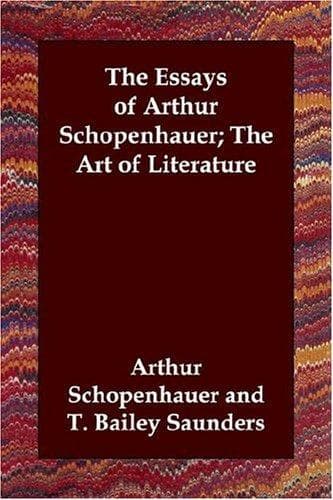
The Essays of Arthur Schopenhauer; The Art of LiteratureSchopenhauer, Arthur
Philosophy
The Essays of Arthur Schopenhauer; The Art of Literature
Schopenhauer, Arthur
Literature -- Philosophy
My remarks are, as I have said, confined to achievements that are not
of any material use. Work that serves some practical end, or ministers
directly to some pleasure of the senses, will never have any
difficulty in being duly appreciated. No first-rate pastry-cook could
long remain obscure in any town, to say nothing of having to appeal to
posterity.
Under fame of rapid growth is also to be reckoned fame of a false
and artificial kind; where, for instance, a book is worked into a
reputation by means of unjust praise, the help of friends, corrupt
criticism, prompting from above and collusion from below. All this
tells upon the multitude, which is rightly presumed to have no power
of judging for itself. This sort of fame is like a swimming bladder,
by its aid a heavy body may keep afloat. It bears up for a certain
time, long or short according as the bladder is well sewed up and
blown; but still the air comes out gradually, and the body sinks. This
is the inevitable fate of all works which are famous by reason of
something outside of themselves. False praise dies away; collusion
comes to an end; critics declare the reputation ungrounded; it
vanishes, and is replaced by so much the greater contempt. Contrarily,
a genuine work, which, having the source of its fame in itself,
can kindle admiration afresh in every age, resembles a body of low
specific gravity, which always keeps up of its own accord, and so goes
floating down the stream of time.
Men of great genius, whether their work be in poetry, philosophy or
art, stand in all ages like isolated heroes, keeping up single-handed
a desperate struggling against the onslaught of an army of
opponents.[1] Is not this characteristic of the miserable nature of
mankind? The dullness, grossness, perversity, silliness and brutality
of by far the greater part of the race, are always an obstacle to the
efforts of the genius, whatever be the method of his art; they so form
that hostile army to which at last he has to succumb. Let the isolated
champion achieve what he may: it is slow to be acknowledged; it is
late in being appreciated, and then only on the score of authority;
it may easily fall into neglect again, at any rate for a while. Ever
afresh it finds itself opposed by false, shallow, and insipid ideas,
which are better suited to that large majority, that so generally hold
the field. Though the critic may step forth and say, like Hamlet when
he held up the two portraits to his wretched mother, _Have you eyes?
Have you eyes_? alas! they have none. When I watch the behavior of a
crowd of people in the presence of some great master's work, and mark
the manner of their applause, they often remind me of trained monkeys
in a show. The monkey's gestures are, no doubt, much like those of
men; but now and again they betray that the real inward spirit of
these gestures is not in them. Their irrational nature peeps out.
Public-domain text, read in full here on John Shaqi.
Reviews
Reviews
No reviews yet
Be the first to share your thoughts on this work.
Elsewhere in the archive
Join the Discussion
Join the discussion
Sign in to leave a comment or review.
Sign InorCreate an account