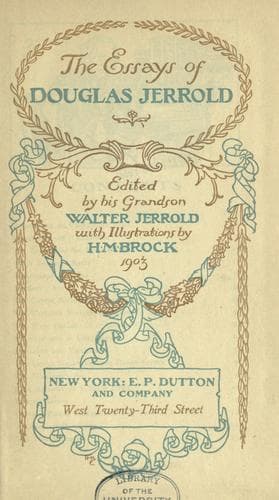
The Essays of Douglas JerroldJerrold, Douglas William
General
The Essays of Douglas Jerrold
Jerrold, Douglas William
English essays -- 19th century
the question, and the ability of the Sergeant mocks the endeavour; for,
he will, on a minute’s notice, resolve how many feet of martial flesh
are in a complete square, after including the triangle, fife, and
drummer lads, and deducting some of the boy officers. Thus,
five-feet-eight reader, if thou wouldst enjoy the pranks of the
Sergeant, unmolested by his eye, teach thy leg to mimic lameness: or, if
easier, cough consumptively.
I would wish to convey a striking resemblance of our Drill Sergeant on
duty, when you would swear by his gait that this glorious earth was
wholly composed of spring wires, so elastic are his soles. It is a
motion unparalleled either in the natural or artificial world; it is a
movement by itself—like the swoop of the eagle, the waddle of the duck,
the fleetness of the greyhound, or the hop of the frog. And yet, on
intense consideration, I think I have seen something approximating to
the bearing of our Drill Sergeant. What think you of the manner of a pug
dog in a dropsy, exposed for air on a nipping December morning, his
black nose turning almost white with indignation at the coldness of the
flags?—There certainly is a resemblance; there is dignity in both
animals, albeit to the daring eye of a grotesque character. It must,
however, be owned, that on great occasions our Sergeant can alter his
deportment. It is not in the nature of things to be always strained to
the highest: the distended skin of the serpent at times falls into
amiable and social wrinkles; an arrant shrew may sometimes be caught
singing “_Sweet Home!_” the bow-string of a William Tell may be
doubtless as relaxed and tuneless as the instrument of a Haymarket
fiddler;—and shall not our Sergeant unbend? He does break himself up
from the stiffness of parade; for see him when the draughts of mine
hostess hath diluted some portion of military starch, and he no longer
holds his head like a game-cock, taking his morning’s potation; see him
then, and own that even a Sergeant may be amiable. Is he not the very
model of elegant ease? He is, indeed, unbent; for his limbs swing
loosely as hung ramrods. Our Sergeant can now talk; his tongue hath
overleapt the two barriers, “Attention!” and “Stand at ease!” and
rambles wildly from Egypt to Waterloo. And if it should happen that the
pretty barmaid be niece to the landlady, mark how the Sergeant probes
for her feelings with charged bayonets—how he will try to smite her
gentle ear with a discharge of artillery—swear that he hath had twenty
wounds under his coat, although very politically adding that they have
left him not a bit the worse man. Then, if the damsel still continue
untouched, taking orders with a calm air, our Sergeant hints in a
whisper, audible to the dozing watchman at the door, something about a
Spanish widow at Saragossa; adding very loudly, “But no—I was always for
true love!” adorning the beautiful edifice of principle with a flowery
oath. He then begins a sentiment, and, at a loss, dives for the
Public-domain text, read in full here on John Shaqi.
Reviews
Reviews
No reviews yet
Be the first to share your thoughts on this work.
Elsewhere in the archive
Join the Discussion
Join the discussion
Sign in to leave a comment or review.
Sign InorCreate an account