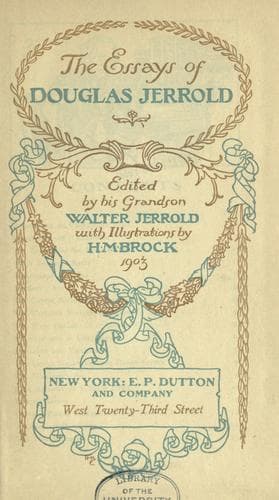
The Essays of Douglas JerroldJerrold, Douglas William
General
The Essays of Douglas Jerrold
Jerrold, Douglas William
English essays -- 19th century
The sentence fell upon me in the days of my earliest childhood; yes, it
was in that ductile, happy, and susceptible season of life that the
words of my uncle Barabbas—precious seed!—dropped into my infant heart,
where—but let me not boast, let me rather indulge in the luxury of
memory—yes, suffer me, complying reader, to carry you into the presence
of my sainted uncle: bear with me whilst with affectionate reverence I
call up from the abyss of time the interesting shadow of Barabbas
Whitefeather.
It was my birthday—I was six years old. I had been promised that that
day should be distinguished by a circumstance which, as we advance in
life and become involved in the meshes of the world, is apt to be
forgotten, albeit of the first importance at the time—I was to be
breeched. _I was not._ I can only remember that a cloud seemed suddenly
to have fallen upon our house—that my father would come home long after
the lamb had lain down to rest, and would still leave the domestic roof
before the rising of the lark, that his temper, generally rough, became
much rougher; and that, only a few days before my birthday, on
expressing my infantine delights at the trumpets blown before the
newly-arrived judges, he rebuked me with unwonted emphasis, at the same
time wishing the trumpets and the judges, as I then conceived, very
oddly incorporated with one another. I was then within a few days of six
years old—I was a fine, tall, plump child, and on my birthday was to
have been breeched. The neighbourhood called for it. I repeat it, my
birthday came and passed, and found and left me still in coats.
That day, however, was ordained to be the most eventful of my life. It
is that day which, if the world shall continue to remember the deeds of
Captain Barabbas Whitefeather, must be held by posterity in especial
respect. It is to that day that I owe everything; and what I owe, it
would be the worst of affectation in the world to deny or to forget. To
proceed with my history.
“Brab,”—it was thus my father was wont to tamper with the euphony of
Barabbas,—“Brab, nunkey wants to see you; so you must toddle with me.”
Some weeks had elapsed since I had seen uncle Barabbas; and at his name
visions of cakes and apples, peg-tops and whipping-tops, rose before me.
Like Agesilaus, Socrates, Yorick, and other men whom I do not hesitate
to call of his kidney, my uncle would chequer and ameliorate the labour
of public life by sporting with little children. “He hath borne me on
his back a thousand times.” I was of course delighted at the prospect of
visiting my uncle; but was at the same time made to wonder at the
preparation of my father, who carefully bound up one of his eyes, glued
large whiskers on his cheeks, and otherwise so disguised himself that,
although I saw him do it, I could scarcely believe it was he. However, I
thought it was all to have some game with Uncle Barabbas—and in my
childishness crowed with laughter at anticipation of the sport.
Public-domain text, read in full here on John Shaqi.
Reviews
Reviews
No reviews yet
Be the first to share your thoughts on this work.
Elsewhere in the archive
Join the Discussion
Join the discussion
Sign in to leave a comment or review.
Sign InorCreate an account