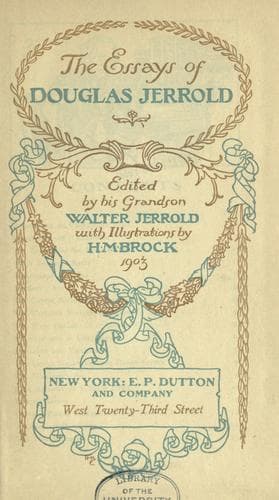
The Essays of Douglas JerroldJerrold, Douglas William
General
The Essays of Douglas Jerrold
Jerrold, Douglas William
English essays -- 19th century
“Are you so ignorant as to believe in the deficiency of mankind in
general—to imagine that nature is so partial a mother as to dower
with her best gifts only a few of her children, leaving the
multitude defenceless, unarmed? My dear sir,”—here my uncle lowered
his voice,—“amend your ignorance—be just to nature. Do you see
tigers whelped without claws—elephants calved that never have
tusks—rattlesnakes hatched with no stings? Is nature so niggard—so
partial—so unjust? No—philosophers and conquerors have made their
marks, and signed their names to the fact—to swindle is to exhibit
the peculiar attribute of the human animal; it is at once the
triumph and distinguishing faculty of the race. But you will say, do
all men swindle? and I ask, do all snakes sting—all elephants gore?
There is, however, an unanswerable argument which proves that men,
when gregarious, are inevitably swindlers; at least, if they are
not, let not the failing be placed to their account; they would be,
if they might. Let me put a case. You recollect Gloss, the retired
merchant? What an excellent man was Gloss! A pattern man to make a
whole generation by! Nobody could surpass him in what is called
honesty, rectitude, moral propriety, and other gibberish. Well,
Gloss joins a ‘Board’; he becomes one of a community; and,
immediately, the latent feeling asserts itself: he is a backbone man
with the rest of his brotherhood; and though as simple Gloss, and
not a member of the ‘board,’ he is the same as ever, yet when acting
with his fellows, when one of the body corporate, when he merges the
man Gloss in the board member, the inherent faculty becomes active,
and he gratifies the instinct, or the refined reason, or whatever
men agree to call it—and complacently swindles with the rest. He
cannot do otherwise: human nature is tested by the occasion; and if,
under the circumstances, he refuse to swindle, he ceases to be a
man. Swindling, my dear sir”—and here my uncle spoke in a tremulous
voice, and my father seemed touched by the emotion—“Swindling, my
dear sir, has indeed a far more comprehensive meaning than that
superficially awarded to it by, possibly, very respectable people.
Good soldiers may fight, pillage, and violate under a banner, and
yet, in truth, shall not be able to read and interpret the legend
emblazoned on it.”
I could perceive that my father did not perfectly understand this. He,
therefore, nodded assentingly, and my uncle, with new animation,
proceeded:—
Public-domain text, read in full here on John Shaqi.
Reviews
Reviews
No reviews yet
Be the first to share your thoughts on this work.
Elsewhere in the archive
Join the Discussion
Join the discussion
Sign in to leave a comment or review.
Sign InorCreate an account