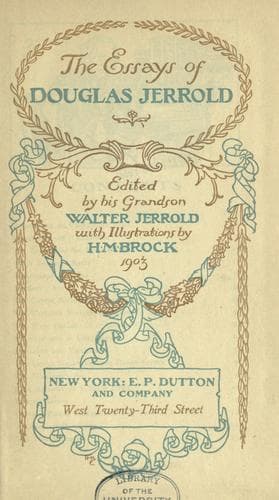
The Essays of Douglas JerroldJerrold, Douglas William
General
The Essays of Douglas Jerrold
Jerrold, Douglas William
English essays -- 19th century
“But why number examples? Why attempt to prove that which every man, if
he would but consult the recesses of his own bosom, must truly know? Ask
all the professions; demand of the lawyer, with yellow, studious cheek,
wherefore he should coin gold out of little strips of paper, written
over by youthful scribes at two or three shillings per diem. Request him
to give you the philosophy of costs—the exquisite meaning of appearance
and declaration, and reply and rejoinder, and all the thousand terms
invented by the most cunning class of labourers, the overlookers at the
building of Babel. Ask the sleek practitioner to what he owes his
fortune. To common-sense—to justice—to the fair and rational barter of
labour for shillings? If he be a hypocrite—if he be resolved to clap in
with the world, and carry on a profitable duplicity, he will swell like
a bull-frog at the query, and, forgetful of his knuckles, will strike
his heart, answering with the big-mouthed ‘Yes!’ But if at the end of a
long practice there should by miracle remain in that attorney’s bosom a
throb of truth, he will blandly, yet significantly smile at the
words—the counters men play with—common-sense and justice, and
magnanimously and unblushingly declare his debt to—swindling!
“Is it otherwise with the physician, who sells his guesses for truth,
and doubts and doubts a patient into the grave, whilst his medicinal
palm is open for the guinea? When the apothecary vends cinnamon and
peppermint water for _elixir vitæ_, doth he practise a noble art? Yea;
for, safely and successfully, he—swindles.
“When the tradesman—his housemaid at the time perhaps in Bridewell for
petty larceny committed on the greasepot—when he, smiling across the
counter at his victim, puts off knowingly the poorest commodity at the
highest price, how stands he in relation to his captive handmaid? Why,
Rebecca has robbed, but the tradesman has only driven his trade: the
slut has for ever and for ever lost her character, with it seven pounds
_per annum_, and, it may be, tea and sugar included—but for Mr Jackson,
her master, he has turned the profit penny; he has—but all in the way of
business—swindled.”
“It is very true,” exclaimed my father with an oath, “it is very true.
When what is swindling isn’t swindling according to law, it’s a fortune
to a man; but when it’s agin law, and found out——”
“The result I know,” cried my uncle, a slight tint of red suffusing his
manly cheek. “All mankind may be divided into two classes: the swindlers
according to custom and to law, and the swindlers according to the bent
of their natural genius.”
“True agin,” cried my father, slapping his thigh.
Public-domain text, read in full here on John Shaqi.
Reviews
Reviews
No reviews yet
Be the first to share your thoughts on this work.
Elsewhere in the archive
Join the Discussion
Join the discussion
Sign in to leave a comment or review.
Sign InorCreate an account