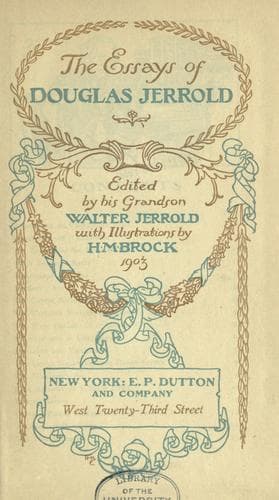
The Essays of Douglas JerroldJerrold, Douglas William
General
The Essays of Douglas Jerrold
Jerrold, Douglas William
English essays -- 19th century
friend Featherfinger—he died, poor fellow, having burst a blood-vessel
from intense study at Macquarrie Harbour—had a magnificent bronze clock;
a superb thing! a thing to make a man value time. Had I not pledged my
honour to secrecy, I could write a history touching his possession of
that clock, which, of itself, is enough to immortalise any one man. My
honour, however, is sacred; and my lips are hushed. This much, probably,
I may be permitted to observe: The industry—nay, that is a poor,
unworthy term—the genius manifested by the indefatigable Featherfinger
to possess that clock—methinks I see him now; poor fellow! seated with
his Greek cap, his black satin morning gown figured with pink poppies—an
Indian shawl (the _gage d’amour_ of an Italian countess) about his
waist—his feet in bead-embroidered slippers, the work, as he protested,
of some heart-devoted heiress—his meerschaum in his mouth—in his hand a
book, _Satan_ or the _Lives of Highwaymen_ (for he was passionately fond
of light literature)—his tiger page, only three feet high, and warranted
to grow no taller, in green and gold, with a breast-plate of best double
gilt buttons, standing at a reverential distance—whilst the bronze clock
on the mantelpiece vibrated with its monitory, moralising—yes,
moralising—_tick, tick!_ Methinks I see him as I enter raise one eye
from the page, nod, smile—and such a smile!—there was only one
shopkeeper, and he was a philosophical member of the Society of Friends
and dealer in _virtu_, that ever stood against it—smile, and then cast
the other eye towards the clock itself with a look of touching reproach
at my delay, or with a glance of approving pleasure at my punctuality.
Methinks I see him—Gracious powers! That such a man should die at
Macquarrie Harbour, taxed beyond his strength of study, a victim to—but
no; loyalty to the Ministry was ever a virtue of the Whitefeathers, and
I breathe no word against the Whigs! To hurry from the theme. Much has
been said about the boldness, the fine contempt of public opinion shown
by Napoleon when he took the horses of St Mark from Venice to place them
on his own palace gate in Paris. Well, the act was not without its
merit, but did I dare to write the story of Featherfinger’s clock, the
theft of Napoleon would, in comparison to the genius manifested by my
friend, sink to the petty larceny committed by schoolboys upon apple
stalls. But so it is; the finest history remains, and ever will remain,
unwritten. The Venice horses have been celebrated by poets and
historians, but posterity is left to bewilder itself with guesses on
Featherfinger’s clock. Yet—and I am prepared to meet the consequences of
such an assertion—I am convinced that great as the conqueror was in all
the varieties of the science, Buonaparte’s horses must pass from the
recollection of the earth; whereas Featherfinger’s clock, duly
chronicled, was a thing for time! It may be cited as an illustration of
Public-domain text, read in full here on John Shaqi.
Reviews
Reviews
No reviews yet
Be the first to share your thoughts on this work.
Elsewhere in the archive
Join the Discussion
Join the discussion
Sign in to leave a comment or review.
Sign InorCreate an account