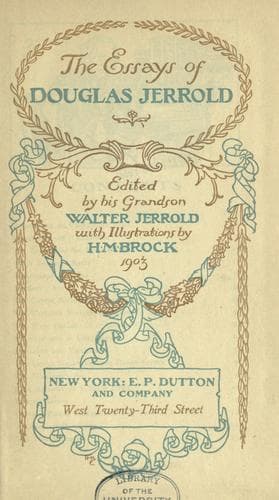
The Essays of Douglas JerroldJerrold, Douglas William
General
The Essays of Douglas Jerrold
Jerrold, Douglas William
English essays -- 19th century
family shall have lived in the dim twilight of civilisation—that he
shall be so far away that all the Herald’s Colleges, with all their
spectacles upon their collective noses, shall not be able to perceive
whether the disentombed thing be flesh or phantom. Very satisfactory
progenitors have been found, with arms to match, of thew and sinew just
as questionable. If, however, the swindler _will_ have a mighty
ancestor, let him, I repeat, go far enough for him: when a man wants a
marquis, or an earl, or a count, for his great-grandfather, he should
not grudge a long walk—even though he walk blindfold and backwards—for
the commodity. So much for the ambitious swindler.
The swindler, however, who trusts to his unassisted genius, and disdains
the lustre of any specious trophies from the churchyard, may with a very
laudable pride refuse to make to himself a grandfather, being possibly
contented with the grandsire selected by his grandmother for him. Some
men—and let me do all homage to their simplicity—turn up their noses at
the genealogical tree, even though its roots were struck at Tyburn: the
swindler of sanguine spirit may be of this proud kidney; and all the
better: I augur more of his ultimate triumph. However, though he shall
refuse a herald-begotten progenitor, it may be highly necessary for him
that he shall choose a name. His own may have become celebrated for
family achievements wide away of his purpose; and therefore, whilst with
filial affection he sticks to his own father and mother, disdaining the
blood of Norman, Guelph, or Ghibelline—it may be imperative upon him to
assume a nominal device not hitherto borne by any of his kin. The
swindler wants a name. Here, then, we approach a delicate, yes, a
difficult point. Let me, however, set out with a solemn injunction to
the swindler, that in the choice of a name “he throw away ambition.”
Considerable nicety is required in the selection of a good title for
swindling; a number of fine young fellows having—if I may lighten the
solemnity of this essay with a familiar phrase—“let the cat out of the
bag” by the incautious assumption of a high-sounding, flowery,
no-meaning patronymic. The truth is, the detestable rage for novels has
so familiarised the world with a set of sugar-and-water heroes—of
exquisite gentlemen, all of them worthy of a glass case lest the flies
should soil them—that their very excess of virtue has put them on the
hue and cry of suspicion. Hence “_Delacour_,” “_Erpingham_,”
“_Rosenthorp_,” “_Millefleur_,” and a thousand others of the courtly and
sweet-smelling class, all in their time excellent names for swindling
(that is, for swindling in the higher sense of the term, for in “fine
wire wove” they swindle still), are now no other than brands,
_stigmata_, by which the calling of the professor is instantly
suspected. Hence, my dear pupil, take no sweet, pastry-cook name from a
novel; cull no flower from a play-bill; but look, as either a poet or a
Public-domain text, read in full here on John Shaqi.
Reviews
Reviews
No reviews yet
Be the first to share your thoughts on this work.
Elsewhere in the archive
Join the Discussion
Join the discussion
Sign in to leave a comment or review.
Sign InorCreate an account