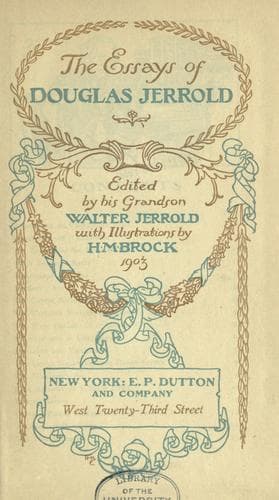
The Essays of Douglas JerroldJerrold, Douglas William
General
The Essays of Douglas Jerrold
Jerrold, Douglas William
English essays -- 19th century
Can you bear what is called public contempt? Are you clothed with a
moral armour, more impenetrable than the scales of the dragon—from which
the glances of reproach, the scoffs, the sneers, the hard abuse of
vulgar minds—the mere pity of those prigs who call themselves
philanthropists—shall fall aside unfelt and unremembered?
Can you school yourself to look in all human faces—for this trial _will_
come—and find them blank?
Have you sufficient fortitude to witness unrepiningly the good fortune
of some early companion—a dullard, yet plodding, and what the world
calls honest—surrounded with all the luxuries of life, the fruits of
lowly huckstering, when, possibly, you yourself are yearning for a
tester?
Can you bear with the nerves of a martyr the visitation of a
horse-whip—for I will not shirk any of the probabilities that wait upon
the profession—or the vindictive and un-Christianlike application of a
pointed boot to the _os sacrum_?[19]
Footnote 19:
“It is very strange,” remarks Captain Whitefeather in one of his
unpublished essays, “On Personal Satisfaction,” “how very few men know
what is due to themselves and to the second party, in inflicting what
they call personal chastisement. I have,” continues the Captain, with
that delightful ingenuousness which made him the soul of his circle,
“I have been kicked, horsewhipped, cudgelled, tossed in a blanket,
pumped upon and flung into a horse-pond, yet I never, but in one
instance, met with a man who thrashed me _like a gentleman_?”—[JOHN
JACKDAW, Ed.]
Can you, at proper time and season, bear your nose pulled? I am aware
that this is perhaps the most difficult, the most trying ordeal for the
weakness of human nature to withstand; and therefore, I repeat the
question—Can you bear your nose pulled?
Can you, with no qualms at your throat, behold in rags or in a gaol the
simple gull who has trusted you, or who—more exquisitely simple
still—has become your surety?
Can you, when old age approaches, and your place in the world is filled
up by more active, more youthful professors—can you, with your hand upon
your heart, retire like a philosopher to a corner, and with not an eye
to look comfort to you, not a lip to breathe hope to you, not a hand to
grasp your hand—can you breathe your last breath with the conviction
that you have done no injury to the dead, will leave no wounds in the
living—and that having passed a life in heroic defiance of human
prejudices, you meet death with the magnanimous indifference of a
roasted Indian?
Consider, my dear pupil, whether you are so happily organised that you
can support these trials—too often attendant on our chivalrous
profession—and answer.
The pupil laughs at the impossibility of such evils, and, chuckling at
the fun, says—I can.
And Swindling takes him to her arms and makes him all her own!
CHAPTER V.
A BRIEF SUMMARY OF THE ADVANTAGES OF SWINDLING
Public-domain text, read in full here on John Shaqi.
Reviews
Reviews
No reviews yet
Be the first to share your thoughts on this work.
Elsewhere in the archive
Join the Discussion
Join the discussion
Sign in to leave a comment or review.
Sign InorCreate an account