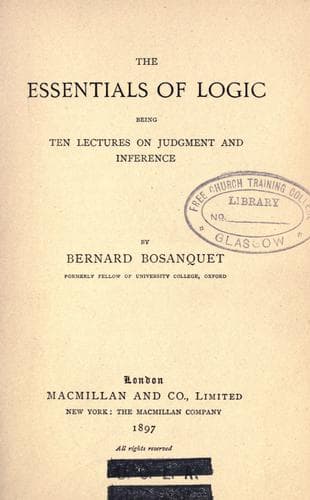
The Essentials of Logic, Being Ten Lectures on Judgment and InferenceBosanquet, Bernard
Philosophy
The Essentials of Logic, Being Ten Lectures on Judgment and Inference
Bosanquet, Bernard
Logic
And it suggests this object because it, the typical element, is a
common point that links together the various cases and the various
presentations in which the object is given to us. In this sense it is a
universal or an identity.
How can this conception of a logical idea be applied to a perfectly
simple presentation? It would be impossible so to apply it, but there
does not seem to be such a thing as a simple presentation in the sense
of a presentation that has no connection as a universal with anything
else. In the image of a particular blue colour, we cannot indeed
separate out what makes it blue from what makes it the particular {78}
shade of blue that it is. But nevertheless its blueness makes it a
symbol to us of blue in general, and when so thought of, crushes out of
sight all the visible peculiarities that attend every spatial surface.
We understand perfectly well that the colour is blue, and that in
saying this we have gone beyond the limits of the momentary image, and
have referred something in it as a universal quality to our world of
objects. An idea, in this sense, is both less and more than a psychical
image. It contains less, but stands for more. It includes only what is
central and characteristic in the detail of each mental presentation,
and therefore omits much. But it is not taken as a mental presentation
at all, but as a content belonging to a systematic world of objects
independent of my thought, and therefore stands for something which is
not mere psychical image.
If therefore we are asked to display it as an image, as something
fixed in a permanent outline, however pale or meagre, we cannot do
so. It is not an abstract image, but a concrete habit or tendency. It
can only be displayed in the judgment, that is, in a concrete case
of reference to reality. Apart from this, it is a mere abstraction
of analysis, a tendency to operate in a certain way upon certain
psychical presentations. Psychically speaking, it is when realised in
judgment a process more or less systematic, extending through time, and
dealing with momentary presentations as its material. In other words,
we may describe it as a selective rule, shown by its workings but not
consciously before the mind--for if it were, it would no longer be an
idea, but an idea of an idea.
Every judgment, whether made with language or without, {79} is an
instance of such an idea, which may be called a symbolic idea as
distinct from a psychical image; “symbolic” because the mental units
or images involved are not as such taken as the whole of the object
for which they stand, but are in a secondary sense, as the word in a
primary sense, symbols or vehicles only.
Public-domain text, read in full here on John Shaqi.
Reviews
Reviews
No reviews yet
Be the first to share your thoughts on this work.
Join the Discussion
Join the discussion
Sign in to leave a comment or review.
Sign InorCreate an account