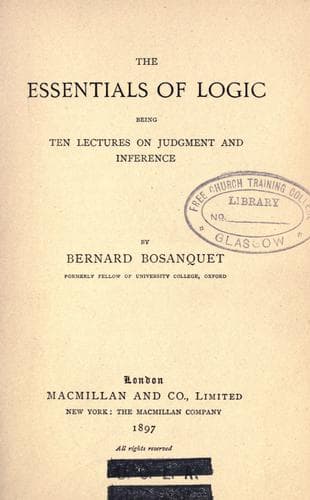
The Essentials of Logic, Being Ten Lectures on Judgment and InferenceBosanquet, Bernard
Philosophy
The Essentials of Logic, Being Ten Lectures on Judgment and Inference
Bosanquet, Bernard
Logic
The commonest and most secure means of reference is {76} the word or
name. [1] So confident are we in the “conventional” or artificially
adapted character of this mark or sign of reference, that we are
inclined to treat it as absolutely unvarying on every occasion of
utterance. But of course it is not unvarying. It differs in sound every
time it is spoken, and in context and appearance every time we see
it in a written shape. Our reliance upon it as identical throughout
depends on the fact that it has a recognisable character to which
its variations are irrelevant, and which practically crushes out
these variations from our attention. Unless we are on the look-out
for mispronunciations or misprints, they do not interfere at all
with our attention to the main reference of words. We know that it
is almost impossible to detect misprints so long as one reads a book
with attention to its meaning. This then is a fair parallel to the
distinction which we are considering between two kinds of ideas. If the
momentary sound or look of a word is analogous to idea as psychical
presentation, “the word” as a permanent possession of our knowledge is
analogous to the idea as a reference to an object in our systematic
world, and is the normal instrument of such a reference.
[1] “A name is a sound which has significance according to
convention,” _i.e._ according to rational agreement.--_Ar. de
Interp_. 16a 19.
But either with the word or without it there may be a symbol of another
kind. Any psychical image that falls within certain limits may appear
as the momentary vehicle of the constant reference to an object. Just
as in recognising the reference of a word we omit to notice the accent
and loudness with which it is pronounced, or the quality of the paper
on which it is printed, just so in recognising the {77} reference of
a psychical image our attention fails to note its momentary context,
colouring, and detail. If it includes something that definitely belongs
to a systematic object in our world of objects, that is enough, unless
counteracted by cross references, to effect the suggestion we require,
and that, and nothing else, arrests our attention for the moment. When
I think of St. Paul’s Cathedral, it may be the west front, or the
dome seen from the outside, or the gallery seen from the inside, that
happens to occur to my mind; and further, that which does occur to me
occurs in a particular form or colouring, dictated by the condition
of my memory and attention at the moment. But these peculiarities are
dwarfed by the meaning, and unless I consider them for psychological
purposes, I do not know that they are there. It is the typical
element only, the element which points to the common reference in
which my interest centres, that forms the content of the idea in this
sense, taken not as a transient feature of the mental complex, but
as definitely suggesting a constant object in our constructed world.
Public-domain text, read in full here on John Shaqi.
Reviews
Reviews
No reviews yet
Be the first to share your thoughts on this work.
Join the Discussion
Join the discussion
Sign in to leave a comment or review.
Sign InorCreate an account