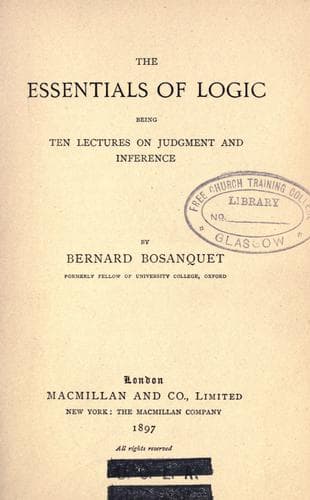
The Essentials of Logic, Being Ten Lectures on Judgment and Inference — John Shaqi
The Essentials of Logic, Being Ten Lectures on Judgment and InferenceBosanquet, Bernard
Philosophy
The Essentials of Logic, Being Ten Lectures on Judgment and Inference
Bosanquet, Bernard
Logic
Such ideas can have truth claimed for them, because they have a
reference beyond their mental existence. They point to an object in
a system of permanent objects, and that to which they point may or
may not suit the relation which they claim for it. Therefore the
judgment can only be made by help of symbolic ideas. Mere mental
facts, occurrences in my mental history, taken as such, cannot enter
into judgment. When we judge about them, as in the last sentence,
they are not themselves subject or predicate, but are referred to,
like any other facts, by help of a selective process dealing with our
current mental images of them. We shall not be far wrong then, if in
every judgment, under whatever disguises it may assume, we look for
elements analogous to those which are manifest in the simple perceptive
judgment, “This is green,” or “That is a horse.” The relation between
these and more elaborate forms of affirmation, such as the abstract
judgment of science, has partly been indicated in the earlier portion
of this lecture. The general definition of judgment has therefore
been sufficiently suggested on p. 72. Judgment is the reference of a
significant idea to a subject in reality, by means of an identity of
content between them.
{80}
LECTURE V THE PROPOSITION AND THE NAME
_Judgment translated into language._
1. Judgment expressed in words is a Proposition. _Must_ Judgment be
expressed in words? We have assumed that this need not be so. Mill [1]
says of Inference that “it is an operation which usually takes place
by means of words, and in complicated cases can take place in no other
way.” The same is true of Judgment.
[1] _Logic_ vol. I. c. i., init.
We may say in general that words are not needed, when thinking about
objects by help of pictorial images will do the work demanded of the
mind, _i.e._ when perfectly individualised connections in space and
time are in question. Mr. Stout [1] gives chess-playing as an example.
With the board before him, even an ordinary player does not need words
to describe to himself the move which he is about to make.
[1] In _Mind_, no. 62.
Public-domain text, read in full here on John Shaqi.
Reviews
Reviews
No reviews yet
Be the first to share your thoughts on this work.
Join the Discussion
Join the discussion
Sign in to leave a comment or review.
Sign InorCreate an account