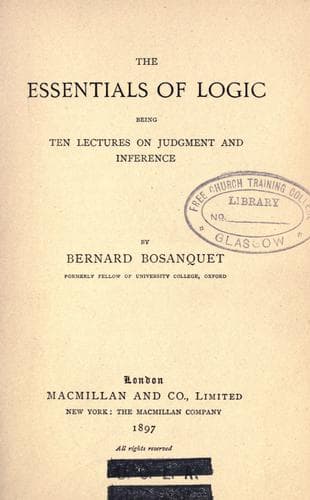
The Essentials of Logic, Being Ten Lectures on Judgment and InferenceBosanquet, Bernard
Philosophy
The Essentials of Logic, Being Ten Lectures on Judgment and Inference
Bosanquet, Bernard
Logic
Words are needed when we have to attend to the general plan of any
system, as in thinking about organisms with reference to their type,
or about political relations--about anything, that is, which is not
of such a nature that the members of the idea can be symbolised in
pictorial form. It would be difficult, for example, to comprehend the
respiration of plants under a symbolic picture-idea drawn {81} from the
respiration of the higher animals. The relations which constitute a
common element between the two processes do not include the movements,
feelings, and visible changes in the circulatory fluid from which our
image of animal respiration is chiefly drawn; and we could hardly
frame a pictorial idea that would duly insist on the chemical and
organic conditions on which the common element of the process depends.
In a case of this kind the word is the symbol which enables us to
hold together in a coherent system, though not in a single image, the
relations which make up the content of our thought.
“Words” may be of many different kinds--spoken, written, indicated
by deaf and dumb signs; all of these are derived from the word as
it is in speech, although writing and printing become practically
independent of sound, and we read, like the deaf and dumb alphabet,
directly by the eye. Then there may be any kind of conventional signals
either for letters, words, or sentences, and any kind of cipher or
_memoria technica_ either for private or for general use--in these the
“conventional” nature of language reaches its climax, and the relation
to a natural growth of speech has disappeared. And finally there are
all forms of picture-writing, which need not, so far as its intrinsic
nature goes, have any connection with speech at all, and which seems to
form a direct transition between picture-thinking and thinking through
the written sign.
All these must be considered under the head of language, as a fixed
system or signs for meanings, before we can ultimately pronounce that
we think without words.
Every Judgment, however, can be expressed in words, {82} though not
every Judgment need be so expressed or can readily be so.
_Proposition and sentence._
2. A Judgment expressed in words is a Proposition, which is one kind
of sentence. A command question or wish is a sentence but not a
proposition. A detached relative clause [1] is not even a complete
sentence. The meaning of the imperative and the question seems to
include some act of _will_; the meaning of a proposition is always
given out simply for fact or truth. We need not consider any sentence
that has no meaning at all.
[1] See above, Lect. IV.
_Difference between Proposition and Judgment_
3. Almost all English logicians speak of the Proposition and not of the
Judgment. [1] This does not matter, so long as we are agreed about what
they mean. They must mean the proposition _as understood_, and this is
what we call the judgment.
[1] So Mill, Venn, Jevons, Bain (see his note, p. 80).
Public-domain text, read in full here on John Shaqi.
Reviews
Reviews
No reviews yet
Be the first to share your thoughts on this work.
Join the Discussion
Join the discussion
Sign in to leave a comment or review.
Sign InorCreate an account