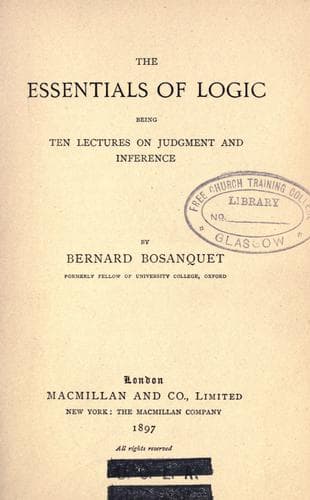
The Essentials of Logic, Being Ten Lectures on Judgment and InferenceBosanquet, Bernard
Philosophy
The Essentials of Logic, Being Ten Lectures on Judgment and Inference
Bosanquet, Bernard
Logic
2. In analysing the Judgment as an act of thought we may begin by
dismissing the separate Copula. It has no separate existence in thought
corresponding to its separate place in the typical proposition of
Formal Logic. It has come to be considered separately, because the
abstract verb “is” is used in our languages as a sign of the complete
enunciation. But there is not in the Judgment any separate significant
idea--any third idea--coming in between the Subject and Predicate of
Judgment. We should try to think of the Copula not as a link, separable
and always {100} intrinsically the same, [1] connecting two distinct
things. We should think of it rather as the grip with which the parts
of a single complex whole cohere with one another, differing according
to the nature of the whole and the inter-dependence of its parts. Benno
Erdmann [2] has strikingly expressed this point of view by saying,
that in the Judgment, “The dead ride fast,” the Subject is “the dead,”
the Predicate “fast riding,” _and the Copula “the fast riding of the
dead_.” In other words, the Copula is simply the Judgment considered
exclusively as a cohesion between parts of a complex idea, the
individual connection between which can only be indicated by supplying
the idea of those parts themselves.
[1] In a comic Logic, with pictures, meant to stimulate dull
minds at a University, I have seen the Copula represented as
the coupling-link between two railway carriages. This is an
excellent type of the way in which we should _not_ think of it.
[2] _Logik_, p. 189.
_Are Subject and Predicate necessary?_
3. The explicit Predicate is more necessary than the explicit Subject.
We have spoken of Judgments expressed by one word, “Fire!” “Thieves!”
etc., and also of impersonal Propositions, “It is raining,” “It
is thawing.” These two classes of Judgments show hardly any
explicit Subject at all. But we could not assert anything without
a Predicate--that would be to assert without asserting anything in
particular.
As these Judgments have, roughly speaking, a Predicate and no
Subject, I do not think it convenient to call them, with Dr. Venn,
existential judgments. It is true that they refer to reality, but their
_peculiarity_ is in not referring to a distinct subject. And when used
for definite and complex assertions they become very artificial, _e.g._
“There is a {101} British Constitution by which our liberties are
guaranteed.” Instead of organising the content of the Judgment, such a
form of assertion simply tosses the whole of it into the Predicate in a
single mass.
Public-domain text, read in full here on John Shaqi.
Reviews
Reviews
No reviews yet
Be the first to share your thoughts on this work.
Elsewhere in the archive
Join the Discussion
Join the discussion
Sign in to leave a comment or review.
Sign InorCreate an account