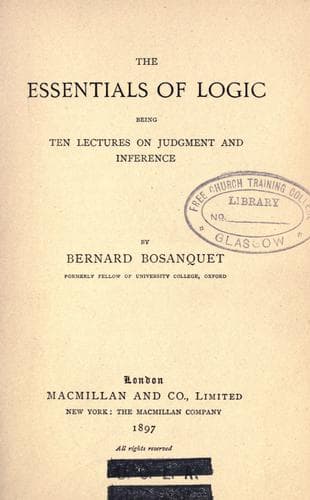
The Essentials of Logic, Being Ten Lectures on Judgment and InferenceBosanquet, Bernard
Philosophy
The Essentials of Logic, Being Ten Lectures on Judgment and Inference
Bosanquet, Bernard
Logic
[1] This assumption involves (see Lecture V.) a confusion
between the Proposition as thoroughly understood, and the
Proposition as a series of partially significant sounds or
signs. For obvious reasons, this confusion is very readily made.
For the operation of Formal Logic it is almost necessary to have
these parts, because it is requisite to transpose the terms (as in
Conversion) without changing their meaning, [1] and to get rid of
_tenses_, which do not belong to Scientific Judgment, and are very
troublesome in Formal Inference.
[1] If the “predicate” is a Substantive, this presents no
difficulty; and if it is an Adjective, it can be done by a
little straining of grammar, or the insertion of “thing” or
“things.” With a verb it is more clumsy.
Thus in Formal Logic we prefer the shape of sentence “Gold is lustrous”
to “Gold glitters,” and “The bridge is {99} cracked” to “There is
a crack in the bridge.” And practically all propositions can be
thrown into this shape, which is convenient for comparing them. The
educational value of elementary formal logic consists chiefly, I am
convinced, in the exercise of paraphrasing poetical or rhetorical
assertions into this typical shape, with the least possible sacrifice
of meaning. The commonest mistakes in the work of beginners, within my
experience as a teacher, consist in failures to interpret rightly the
sentence given for analysis.
But this type is not really ultimate. The judgment can be conveyed
without a grammatical subject, and without the verb “is”--indeed
without any grammatical verb at all. On the whole this agrees with
Mill’s view in the chapter “Of Propositions.” [1] He points out (§ 1)
that we really need nothing but the Subject and Predicate, and that the
copula is a mere sign of their connection _as_ Subject and Predicate.
He does not, however, discuss the case in which the grammatical Subject
is absent.
[1] Mill’s _Logic_, Bk. I. ch. iv.
_Copula_
Public-domain text, read in full here on John Shaqi.
Reviews
Reviews
No reviews yet
Be the first to share your thoughts on this work.
Elsewhere in the archive
Join the Discussion
Join the discussion
Sign in to leave a comment or review.
Sign InorCreate an account