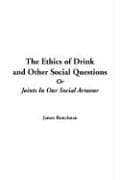
The Ethics of Drink and Other Social Questions; Or, Joints In Our Social ArmourRunciman, James
Philosophy
The Ethics of Drink and Other Social Questions; Or, Joints In Our Social Armour
Runciman, James
Alcoholism -- Great Britain; Social problems; Temperance
Here we have an absurdity quite fairly exposed. The young American
student who acts as a reporter or waiter during his college vacation is
nearly always a respectful gentleman who neither takes nor allows a
liberty; but the underbred boor, keen as he is about his gratuities,
will take even your gifts as though he were an Asiatic potentate, and
the traveller a passing slave whose tribute is condescendingly received.
In a word, the servant goes out of his way to prove that, in his own
idea, he is quite fit to be anybody's master. The Declaration of
Independence informs us that all men are born equal; the transatlantic
servant takes that with a certain reservation, for he implies that,
though men may be equal in a general way, yet, so far as he is
concerned, he prefers to reckon himself the superior of anybody with
whom business brings him into contact.
It was in America that I first began to meditate on the problem of
equality, and I have given it much thought at intervals during several
years. The great difficulty is to avoid repeating stale commonplaces on
the matter. The robust Briton bellows, "Equality! Divide up all the
property in the world equally among the inhabitants, and there would be
rich and poor, just as before, within a week!" The robust man thinks
that settles the whole matter at once. Then we have the stock story of
the three practical communists who forced themselves upon the society of
Baron Rothschild, and explained their views at some length. The Baron
said: "Gentlemen, I have made a little calculation, and I find that, if
I divided my property equally among my fellow-citizens, your share would
be one florin each. Oblige me by accepting that sum at once, and permit
me to wish you good-morning." This was very neat in its way, but I want
to talk just a little more seriously of a problem which concerns the
daily life of us all, and affects our mental health, our placidity, and
our self-respect very intimately. In the first place, we have to
consider the deplorable exhibitions made by poor humanity whenever
equality has been fairly insisted on in any community. The Frenchmen of
1792 thought that a great principle had been asserted when the President
of the Convention said to the king, "You may sit down, Louis." It seemed
fine to the gallery when the queenly Marie Antoinette was addressed as
the widow Capet; but what a poor business it was after all! The howling
familiarity of the mob never touched the real dignity of the royal
woman, and their brutality was only a murderous form of Yankee servant's
mean "independence." I cannot treat the subject at all without going
into necessary subtleties which never occurred to an enraged mob or a
bloodthirsty and insolent official; I cannot accept the bald jeers of a
comfortable, purse-proud citizen as being of any weight, and I am just
as loath to heed the wire-drawn platitudes of the average philosopher.
If we accept the very first maxim of biology, and agree that no two
Public-domain text, read in full here on John Shaqi.
Reviews
Reviews
No reviews yet
Be the first to share your thoughts on this work.
Elsewhere in the archive
Join the Discussion
Join the discussion
Sign in to leave a comment or review.
Sign InorCreate an account