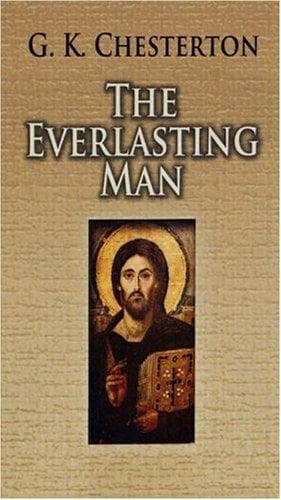
The Everlasting ManChesterton, G. K. (Gilbert Keith)
Religion
The Everlasting Man
Chesterton, G. K. (Gilbert Keith)
Catholic Church -- Apologetic works; Christianity and other religions; Religion
In any case it is clear enough that the painted and gilded civilisation
of tropical America systematically indulged in human sacrifice. It is by
no means clear, so far as I know, that the Eskimos ever indulged in
human sacrifice. They were not civilised enough. They were too closely
imprisoned by the white winter and the endless dark. Chill penury
repressed their noble rage and froze the genial current of the soul. It
was in brighter days and broader daylight that the noble rage is found
unmistakably raging. It was in richer and more instructed lands that the
genial current flowed on the altars, to be drunk by great gods wearing
goggling and grinning masks and called on in terror or torment by long
cacophonous names that sound like laughter in hell. A warmer climate and
a more scientific cultivation were needed to bring forth these blooms;
to draw up towards the sun the large leaves and flamboyant blossoms that
gave their gold and crimson and purple to that garden, which Swinburne
compares to the Hesperides. There was at least no doubt about the
dragon.
I do not raise in this connection the special controversy about Spain
and Mexico; but I may remark in passing that it resembles exactly the
question that must in some sense be raised afterwards about Rome and
Carthage. In both cases there has been a queer habit among the English
of always siding against the Europeans, and representing the rival
civilisation, in Swinburne’s phrase, as sinless; when its sins were
obviously crying or rather screaming to heaven. For Carthage also was a
high civilisation, indeed a much more highly civilised civilisation. And
Carthage also founded that civilisation on a religion of fear, sending
up everywhere the smoke of human sacrifice. Now it is very right to
rebuke our own race or religion for falling short of our own standards
and ideals. But it is absurd to pretend that they fell lower than the
other races and religions that professed the very opposite standards and
ideals. There is a very real sense in which the Christian is worse than
the heathen, the Spaniard worse than the Red Indian, or even the Roman
potentially worse than the Carthaginian. But there is only one sense in
which he is worse; and that is not in being positively worse. The
Christian is only worse because it is his business to be better.
Public-domain text, read in full here on John Shaqi.
Reviews
Reviews
No reviews yet
Be the first to share your thoughts on this work.
Elsewhere in the archive
Join the Discussion
Join the discussion
Sign in to leave a comment or review.
Sign InorCreate an account