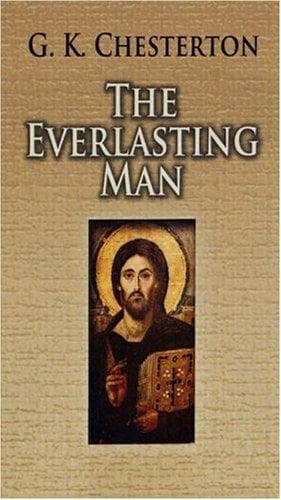
The Everlasting ManChesterton, G. K. (Gilbert Keith)
Religion
The Everlasting Man
Chesterton, G. K. (Gilbert Keith)
Catholic Church -- Apologetic works; Christianity and other religions; Religion
Anyhow the part of such speculations that concerns this story centred
especially round that eastern end of the Mediterranean where the nomads
had turned gradually into traders and had begun to trade with the whole
world. Indeed in the sense of trade and travel and colonial extension,
it already had something like an empire of the whole world. Its purple
dye, the emblem of its rich pomp and luxury, had steeped the wares which
were sold far away amid the last crags of Cornwall and the sails that
entered the silence of tropic seas amid all the mystery of Africa. It
might be said truly to have painted the map purple. It was already a
world-wide success, when the princes of Tyre would hardly have troubled
to notice that one of their princesses had condescended to marry the
chief of some tribe called Judah; when the merchants of its African
outpost would only have curled their bearded and Semitic lips with a
slight smile at the mention of a village called Rome. And indeed no two
things could have seemed more distant from each other, not only in space
but in spirit, than the monotheism of the Palestinian tribe and the very
virtues of the small Italian republic. There was but one thing between
them; and the thing which divided them has united them. Very various and
incompatible were the things that could be loved by the consuls of Rome
and the prophets of Israel; but they were at one in what they hated. It
is very easy in both cases to represent that hatred as something merely
hateful. It is easy enough to make a merely harsh and inhuman figure
either of Elijah raving above the slaughter of Carmel or Cato thundering
against the amnesty of Africa. These men had their limitations and their
local passions; but this criticism of them is unimaginative and
therefore unreal. It leaves out something, something immense and
intermediate, facing east and west and calling up this passion in its
eastern and western enemies; and that something is the first subject of
this chapter.
Public-domain text, read in full here on John Shaqi.
Reviews
Reviews
No reviews yet
Be the first to share your thoughts on this work.
Elsewhere in the archive
Join the Discussion
Join the discussion
Sign in to leave a comment or review.
Sign InorCreate an account