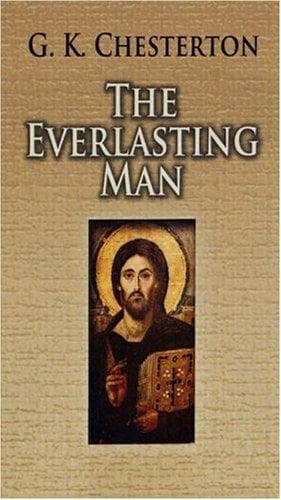
The Everlasting ManChesterton, G. K. (Gilbert Keith)
Religion
The Everlasting Man
Chesterton, G. K. (Gilbert Keith)
Catholic Church -- Apologetic works; Christianity and other religions; Religion
But Reincarnation is not really a mystical idea. It is not really a
transcendental idea, or in that sense a religious idea. Mysticism
conceives something transcending experience; religion seeks glimpses of
a better good or a worse evil than experience can give. Reincarnation
need only extend experiences in the sense of repeating them. It is no
more transcendental for a man to remember what he did in Babylon before
he was born than to remember what he did in Brixton before he had a
knock on the head. His successive lives _need_ not be any more than
human lives, under whatever limitations burden human life. It has
nothing to do with seeing God or even conjuring up the devil. In other
words, reincarnation as such does not necessarily escape from the wheel
of destiny; in some sense it is the wheel of destiny. And whether it was
something that Buddha founded, or something that Buddha found, or
something that Buddha entirely renounced when he found, it is certainly
something having the general character of that Asiatic atmosphere in
which he had to play his part. And the part he played was that of an
intellectual philosopher, with a particular theory about the right
intellectual attitude towards it.
I can understand that Buddhists might resent the view that Buddhism is
merely a philosophy, if we understand by a philosophy merely an
intellectual game such as Greek sophists played, tossing up worlds and
catching them like balls. Perhaps a more exact statement would be that
Buddha was a man who made a metaphysical discipline; which might even be
called a psychological discipline. He proposed a way of escaping from
all this recurrent sorrow; and that was simply by getting rid of the
delusion that is called desire. It was emphatically _not_ that we should
get what we want better by restraining our impatience for part of it, or
that we should get it in a better way or in a better world. It was
emphatically that we should leave off wanting it. If once a man realised
that there is really no reality, that everything, including his soul, is
in dissolution at every instant, he would anticipate disappointment and
be intangible to change, existing (in so far as he could be said to
exist) in a sort of ecstasy of indifference. The Buddhists call this
beatitude, and we will not stop our story to argue the point; certainly
to us it is indistinguishable from despair. I do not see, for instance,
why the disappointment of desire should not apply as much to the most
benevolent desires as to the most selfish ones. Indeed the Lord of
Compassion seems to pity people for living rather than for dying. For
the rest, an intelligent Buddhist wrote, ‘The explanation of popular
Chinese and Japanese Buddhism is that it is not Buddhism.’ _That_ has
doubtless ceased to be a mere philosophy, but only by becoming a mere
mythology. One thing is certain: it has never become anything remotely
resembling what we call a Church.
Public-domain text, read in full here on John Shaqi.
Reviews
Reviews
No reviews yet
Be the first to share your thoughts on this work.
Elsewhere in the archive
Join the Discussion
Join the discussion
Sign in to leave a comment or review.
Sign InorCreate an account