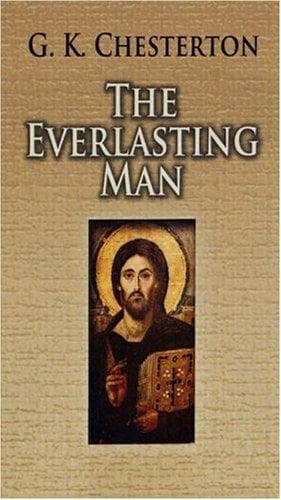
The Everlasting ManChesterton, G. K. (Gilbert Keith)
Religion
The Everlasting Man
Chesterton, G. K. (Gilbert Keith)
Catholic Church -- Apologetic works; Christianity and other religions; Religion
In other words, the cross, in fact as well as figure, does really stand
for the idea of breaking out of the circle that is everything and
nothing. It does escape from the circular argument by which everything
begins and ends in the mind. Since we are still dealing in symbols, it
might be put in a parable in the form of that story about St. Francis,
which says that the birds departing with his benediction could wing
their way into the infinities of the four winds of heaven, their tracks
making a vast cross upon the sky; for compared with the freedom of that
flight of birds, the very shape of the Swastika is like a kitten chasing
its tail. In a more popular allegory, we might say that when St. George
thrust his spear into the monster’s jaws, he broke in upon the solitude
of the self-devouring serpent and gave it something to bite besides its
own tail. But while many fancies might be used as figures of the truth,
the truth itself is abstract and absolute; though it is not very easy to
sum up except by such figures. Christianity does appeal to a solid truth
outside itself; to something which is in that sense external as well as
eternal. It does declare that things are really there; or in other
words that things are really things. In this Christianity is at one with
common sense; but all religious history shows that this common sense
perishes except where there is Christianity to preserve it.
It cannot otherwise exist, or at least endure, because mere thought does
not remain sane. In a sense it becomes too simple to be sane. The
temptation of the philosophers is simplicity rather than subtlety. They
are always attracted by insane simplifications, as men poised above
abysses are fascinated by death and nothingness and the empty air. It
needed another kind of philosopher to stand poised upon the pinnacle of
the Temple and keep his balance without casting himself down. One of
these obvious, these too obvious explanations is that everything is a
dream and a delusion and there is nothing outside the ego. Another is
that all things recur; another, which is said to be Buddhist and is
certainly Oriental, is the idea that what is the matter with us is our
creation, in the sense of our coloured differentiation and personality,
and that nothing will be well till we are again melted into one unity.
By this theory, in short, the Creation was the Fall. It is important
historically because it was stored up in the dark heart of Asia and went
forth at various times in various forms over the dim borders of Europe.
Here we can place the mysterious figure of Manes or Manichaeus, the
mystic of inversion, whom we should call a pessimist, parent of many
sects and heresies; here, in a higher place, the figure of Zoroaster. He
has been popularly identified with another of these too simple
explanations: the equality of evil and good, balanced and battling in
every atom. He also is of the school of sages that may be called
Public-domain text, read in full here on John Shaqi.
Reviews
Reviews
No reviews yet
Be the first to share your thoughts on this work.
Elsewhere in the archive
Join the Discussion
Join the discussion
Sign in to leave a comment or review.
Sign InorCreate an account