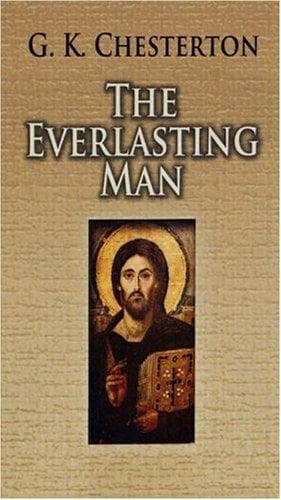
The Everlasting ManChesterton, G. K. (Gilbert Keith)
Religion
The Everlasting Man
Chesterton, G. K. (Gilbert Keith)
Catholic Church -- Apologetic works; Christianity and other religions; Religion
But there is a deeper fallacy besides this obvious fact; that men need
not live for food merely because they cannot live without food. The
truth is that the thing most present to the mind of man is not the
economic machinery necessary to his existence, but rather that existence
itself; the world which he sees when he wakes every morning and the
nature of his general position in it. There is something that is nearer
to him than livelihood, and that is life. For once that he remembers
exactly what work produces his wages and exactly what wages produce his
meals, he reflects ten times that it is a fine day or it is a queer
world, or wonders whether life is worth living, or wonders whether
marriage is a failure, or is pleased and puzzled with his own children,
or remembers his own youth, or in any such fashion vaguely reviews the
mysterious lot of man. This is true of the majority even of the
wage-slaves of our morbid modern industrialism, which by its hideousness
and inhumanity has really forced the economic issue to the front. It is
immeasurably more true of the multitude of peasants or hunters or
fishers who make up the real mass of mankind. Even those dry pedants who
think that ethics depend on economics must admit that economics depend
on existence. And any number of normal doubts and day-dreams are about
existence; not about how we can live, but about why we do. And the proof
of it is simple; as simple as suicide. Turn the universe upside down in
the mind and you turn all the political economists upside down with it.
Suppose that a man wishes to die, and the professor of political economy
becomes rather a bore with his elaborate explanations of how he is to
live. And all the departures and decisions that make our human past into
a story have this character of diverting the direct course of pure
economics. As the economist may be excused from calculating the future
salary of a suicide, so he may be excused from providing an old-age
pension for a martyr. As he need not provide for the future of a martyr,
so he need not provide for the family of a monk. His plan is modified in
lesser and varying degrees by a man being a soldier and dying for his
own country, by a man being a peasant and specially loving his own land,
by a man being more or less affected by any religion that forbids or
allows him to do this or that. But all these come back not to an
economic calculation about livelihood but to an elemental outlook upon
life. They all come back to what a man fundamentally feels, when he
looks forth from those strange windows which we call the eyes, upon that
strange vision that we call the world.
Public-domain text, read in full here on John Shaqi.
Reviews
Reviews
No reviews yet
Be the first to share your thoughts on this work.
Elsewhere in the archive
Join the Discussion
Join the discussion
Sign in to leave a comment or review.
Sign InorCreate an account