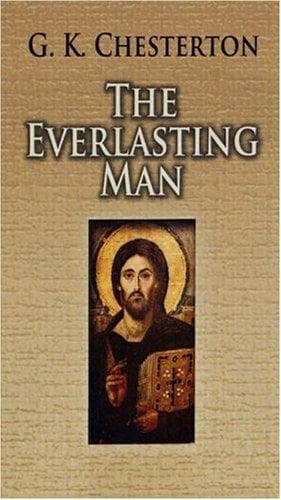
The Everlasting ManChesterton, G. K. (Gilbert Keith)
Religion
The Everlasting Man
Chesterton, G. K. (Gilbert Keith)
Catholic Church -- Apologetic works; Christianity and other religions; Religion
There is something we all know which can only be rendered, in an
appropriate language, as _realpolitik_. As a matter of fact, it is an
almost insanely unreal politik. It is always stubbornly and stupidly
repeating that men fight for material ends, without reflecting for a
moment that the material ends are hardly ever material to the men who
fight. In any case, no man will die for practical politics, just as no
man will die for pay. Nero could not hire a hundred Christians to be
eaten by lions at a shilling an hour; for men will not be martyred for
money. But the vision called up by real politik, or realistic politics,
is beyond example crazy and incredible. Does anybody in the world
believe that a soldier says, ‘My leg is nearly dropping off, but I shall
go on till it drops; for after all I shall enjoy all the advantages of
my government obtaining a warm-water port in the Gulf of Finland.’ Can
anybody suppose that a clerk turned conscript says, ‘If I am gassed I
shall probably die in torments; but it is a comfort to reflect that
should I ever decide to become a pearl-diver in the South Seas, that
career is now open to me and my countrymen.’ Materialist history is the
most madly incredible of all histories, or even of all romances.
Whatever starts wars, the thing that sustains wars is something in the
soul; that is something akin to religion. It is what men feel about life
and about death. A man near to death is dealing directly with an
absolute; it is nonsense to say he is concerned only with relative and
remote complications that death in any case will end. If he is sustained
by certain loyalties, they must be loyalties as simple as death. They
are generally two ideas, which are only two sides of one idea. The first
is the love of something said to be threatened, if it be only vaguely
known as home; the second is dislike and defiance of some strange thing
that threatens it. The first is far more philosophical than it sounds,
though we need not discuss it here. A man does not want his national
home destroyed or even changed, because he cannot even remember all the
good things that go with it; just as he does not want his house burnt
down, because he can hardly count all the things he would miss.
Therefore he fights for what sounds like a hazy abstraction, but is
really a house. But the negative side of it is quite as noble as well as
quite as strong. Men fight hardest when they feel that the foe is at
once an old enemy and an eternal stranger, that his atmosphere is alien
and antagonistic; as the French feel about the Prussian or the Eastern
Christians about the Turk. If we say it is a difference of religion,
people will drift into dreary bickerings about sects and dogmas. We will
pity them and say it is a difference about death and daylight; a
difference that does really come like a dark shadow between our eyes and
the day. Men can think of this difference even at the point of death;
for it is a difference about the meaning of life.
Public-domain text, read in full here on John Shaqi.
Reviews
Reviews
No reviews yet
Be the first to share your thoughts on this work.
Elsewhere in the archive
Join the Discussion
Join the discussion
Sign in to leave a comment or review.
Sign InorCreate an account