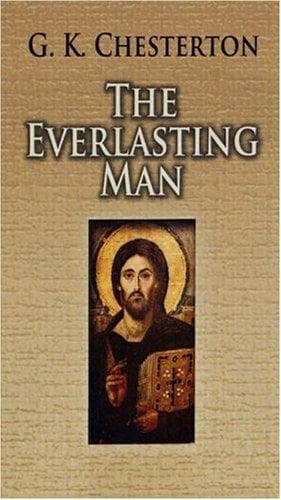
The Everlasting ManChesterton, G. K. (Gilbert Keith)
Religion
The Everlasting Man
Chesterton, G. K. (Gilbert Keith)
Catholic Church -- Apologetic works; Christianity and other religions; Religion
The ancient religion of Italy was on the whole that mixture which we
have considered under the head of mythology; save that where the Greeks
had a natural turn for the mythology, the Latins seem to have had a real
turn for religion. Both multiplied gods, yet they sometimes seem to have
multiplied them for almost opposite reasons. It would seem sometimes as
if the Greek polytheism branched and blossomed upwards like the boughs
of a tree, while the Italian polytheism ramified downward like the
roots. Perhaps it would be truer to say that the former branches lifted
themselves lightly, bearing flowers; while the latter hung down, being
heavy with fruit. I mean that the Latins seem to multiply gods to bring
them nearer to men, while the Greek gods rose and radiated outwards into
the morning sky. What strikes us in the Italian cults is their local and
especially their domestic character. We gain the impression of
divinities swarming about the house like flies; of deities clustering
and clinging like bats about the pillars or building like birds under
the eaves. We have a vision of a god of roofs and a god of gateposts, of
a god of doors and even a god of drains. It has been suggested that all
mythology was a sort of fairy-tale; but this was a particular sort of
fairy-tale which may truly be called a fireside tale, or a nursery-tale;
because it was a tale of the interior of the home; like those which make
chairs and tables talk like elves. The old household gods of the Italian
peasants seem to have been great, clumsy, wooden images, more
featureless than the figure-head which Quilp battered with the poker.
This religion of the home was very homely. Of course there were other
less human elements in the tangle of Italian mythology. There were Greek
deities superimposed on the Roman; there were here and there uglier
things underneath, experiments in the cruel kind of paganism, like the
Arician rite of the priest slaying the slayer. But these things were
always potential in paganism; they are certainly not the peculiar
character of Latin paganism. The peculiarity of that may be roughly
covered by saying that if mythology personified the forces of nature,
this mythology personified nature as transformed by the forces of man.
It was the god of the corn and not of the grass, of the cattle and not
the wild things of the forest; in short, the cult was literally a
culture; as when we speak of it as agriculture.
Public-domain text, read in full here on John Shaqi.
Reviews
Reviews
No reviews yet
Be the first to share your thoughts on this work.
Elsewhere in the archive
Join the Discussion
Join the discussion
Sign in to leave a comment or review.
Sign InorCreate an account