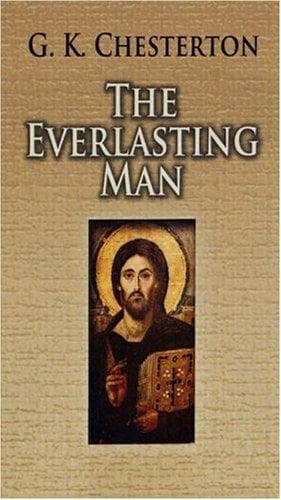
The Everlasting ManChesterton, G. K. (Gilbert Keith)
Religion
The Everlasting Man
Chesterton, G. K. (Gilbert Keith)
Catholic Church -- Apologetic works; Christianity and other religions; Religion
The truth is that when critics have spoken of the local limitations of
the Galilean, it has always been a case of the local limitations of the
critics. He did undoubtedly believe in certain things that one
particular modern sect of materialists do not believe. But they were not
things particularly peculiar to his time. It would be nearer the truth
to say that the denial of them is quite peculiar to our time. Doubtless
it would be nearer still to the truth to say merely that a certain
solemn social importance, in the minority disbelieving them, is peculiar
to our time. He believed, for instance, in evil spirits or in the
psychic healing of bodily ills; but not because he was a Galilean born
under Augustus. It is absurd to say that a man believed things because
he was a Galilean under Augustus when he might have believed the same
things if he had been an Egyptian under Tuten-kamen or an Indian under
Gengis Khan. But with this general question of the philosophy of
diabolism or of divine miracles I deal elsewhere. It is enough to say
that the materialists have to prove the impossibility of miracles
against the testimony of all mankind, not against the prejudices of
provincials in North Palestine under the first Roman Emperors. What they
have to prove, for the present argument, is the presence in the Gospels
of those particular prejudices of those particular provincials. And,
humanly speaking, it is astonishing how little they can produce even to
make a beginning of proving it.
So it is in this case of the sacrament of marriage. We may not believe
in sacraments, as we may not believe in spirits, but it is quite clear
that Christ believed in this sacrament in his own way and not in any
current or contemporary way. He certainly did not get his argument
against divorce from the Mosaic law or the Roman law or the habits of
the Palestinian people. It would appear to his critics then exactly what
it appears to his critics now; an arbitrary and transcendental dogma
coming from nowhere save in the sense that it came from him. I am not at
all concerned here to defend that dogma; the point here is that it is
just as easy to defend it now as it was to defend it then. It is an
ideal altogether outside time; difficult at any period; impossible at no
period. In other words, if any one says it is what might be expected of
a man walking about in that place at that period, we can quite fairly
answer that it is much _more_ like what might be the mysterious
utterance of a being beyond man, if he walked alive among men.
Public-domain text, read in full here on John Shaqi.
Reviews
Reviews
No reviews yet
Be the first to share your thoughts on this work.
Elsewhere in the archive
Join the Discussion
Join the discussion
Sign in to leave a comment or review.
Sign InorCreate an account