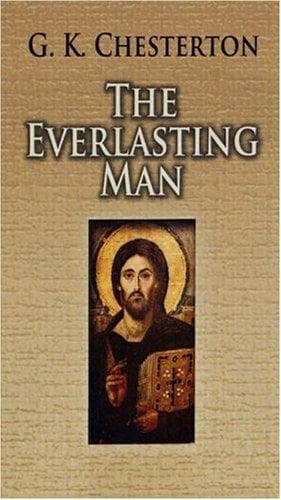
The Everlasting ManChesterton, G. K. (Gilbert Keith)
Religion
The Everlasting Man
Chesterton, G. K. (Gilbert Keith)
Catholic Church -- Apologetic works; Christianity and other religions; Religion
But that paradise was not clear until Christianity had gradually cleared
it. The pagan world, as such, would not have understood any such thing
as a serious suggestion that a child is higher or holier than a man. It
would have seemed like the suggestion that a tadpole is higher or holier
than a frog. To the merely rationalistic mind, it would sound like
saying that a bud must be more beautiful than a flower or that an unripe
apple must be better than a ripe one. In other words, this modern
feeling is an entirely mystical feeling. It is quite as mystical as the
cult of virginity; in fact it is the cult of virginity. But pagan
antiquity had much more idea of the holiness of the virgin than of the
holiness of the child. For various reasons we have come nowadays to
venerate children; perhaps partly because we envy children for still
doing what men used to do; such as play simple games and enjoy
fairy-tales. Over and above this, however, there is a great deal of real
and subtle psychology in our appreciation of childhood; but if we turn
it into a modern discovery, we must once more admit that the historical
Jesus of Nazareth had already discovered it two thousand years too soon.
There was certainly nothing in the world around him to help him to the
discovery. Here Christ was indeed human; but more human than a human
being was then likely to be. Peter Pan does not belong to the world of
Pan but the world of Peter.
Even in the matter of mere literary style, if we suppose ourselves thus
sufficiently detached to look at it in that light, there is a curious
quality to which no critic seems to have done justice. It had among
other things a singular air of piling tower upon tower by the use of the
_a fortiori_; making a pagoda of degrees like the seven heavens. I have
already noted that almost inverted imaginative vision which pictured
the impossible penance of the Cities of the Plain. There is perhaps
nothing so perfect in all language or literature as the use of these
three degrees in the parable of the lilies of the field; in which he
seems first to take one small flower in his hand and note its simplicity
and even its impotence; then suddenly expands it in flamboyant colours
into all the palaces and pavilions full of a great name in national
legend and national glory; and then, by yet a third overturn, shrivels
it to nothing once more with a gesture as if flinging it away ’... and
if God so clothes the grass that to-day is and to-morrow is cast into
the oven--how much more....’ It is like the building of a good Babel
tower by white magic in a moment and in the movement of a hand; a tower
heaved suddenly up to heaven on the top of which can be seen afar off,
higher than we had fancied possible, the figure of man; lifted by three
infinities above all other things, on a starry ladder of light logic and
swift imagination. Merely in a literary sense it would be more of a
masterpiece than most of the masterpieces in the libraries; yet it seems
Public-domain text, read in full here on John Shaqi.
Reviews
Reviews
No reviews yet
Be the first to share your thoughts on this work.
Elsewhere in the archive
Join the Discussion
Join the discussion
Sign in to leave a comment or review.
Sign InorCreate an account