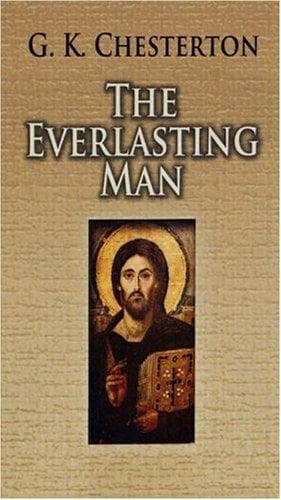
The Everlasting ManChesterton, G. K. (Gilbert Keith)
Religion
The Everlasting Man
Chesterton, G. K. (Gilbert Keith)
Catholic Church -- Apologetic works; Christianity and other religions; Religion
Therefore the story of Christ is the story of a journey, almost in the
manner of a military march; certainly in the manner of the quest of a
hero moving to his achievement or his doom. It is a story that begins in
the paradise of Galilee, a pastoral and peaceful land having really some
hint of Eden, and gradually climbs the rising country into the mountains
that are nearer to the storm-clouds and the stars, as to a Mountain of
Purgatory. He may be met as if straying in strange places, or stopped on
the way for discussion or dispute; but his face is set towards the
mountain city. That is the meaning of that great culmination when he
crested the ridge and stood at the turning of the road and suddenly
cried aloud, lamenting over Jerusalem. Some light touch of that lament
is in every patriotic poem; or if it is absent, the patriotism stinks
with vulgarity. That is the meaning of the stirring and startling
incident at the gates of the Temple, when the tables were hurled like
lumber down the steps, and the rich merchants driven forth with bodily
blows; the incident that must be at least as much of a puzzle to the
pacifists as any paradox about non-resistance can be to any of the
militarists. I have compared the quest to the journey of Jason, but we
must never forget that in a deeper sense it is rather to be compared to
the journey of Ulysses. It was not only a romance of travel but a
romance of return; and of the end of a usurpation. No healthy boy
reading the story regards the rout of the Ithacan suitors as anything
but a happy ending. But there are doubtless some who regard the rout of
the Jewish merchants and moneychangers with that refined repugnance
which never fails to move them in the presence of violence, and
especially of violence against the well-to-do. The point here, however,
is that all these incidents have in them a character of mounting crisis.
In other words, these incidents are not incidental. When Apollonius the
ideal philosopher is brought before the judgment-seat of Domitian and
vanishes by magic, the miracle is entirely incidental. It might have
occurred at any time in the wandering life of the Tyanean; indeed, I
believe it is doubtful in date as well as in substance. The ideal
philosopher merely vanished, and resumed his ideal existence somewhere
else for an indefinite period. It is characteristic of the contrast
perhaps that Apollonius was supposed to have lived to an almost
miraculous old age. Jesus of Nazareth was less prudent in his miracles.
When Jesus was brought before the judgment-seat of Pontius Pilate, he
did not vanish. It was the crisis and the goal; it was the hour and the
power of darkness. It was the supremely supernatural act, of all his
miraculous life, that he did not vanish.
Public-domain text, read in full here on John Shaqi.
Reviews
Reviews
No reviews yet
Be the first to share your thoughts on this work.
Elsewhere in the archive
Join the Discussion
Join the discussion
Sign in to leave a comment or review.
Sign InorCreate an account