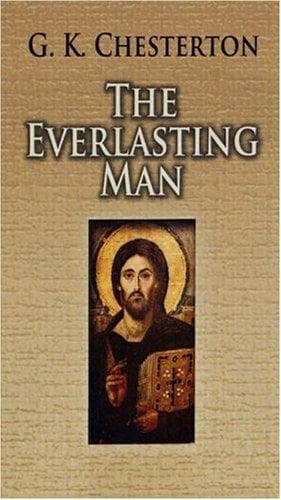
The Everlasting ManChesterton, G. K. (Gilbert Keith)
Religion
The Everlasting Man
Chesterton, G. K. (Gilbert Keith)
Catholic Church -- Apologetic works; Christianity and other religions; Religion
It is more within my powers, and here more immediately to my purpose, to
point out that in that scene were symbolically gathered all the human
forces that have been vaguely sketched in this story. As kings and
philosophers and the popular element had been symbolically present at
his birth, so they were more practically concerned in his death; and
with that we come face to face with the essential fact to be realised.
All the great groups that stood about the Cross represent in one way or
another the great historical truth of the time; that the world could not
save itself. Man could do no more. Rome and Jerusalem and Athens and
everything else were going down like a sea turned into a slow cataract.
Externally indeed the ancient world was still at its strongest; it is
always at that moment that the inmost weakness begins. But in order to
understand that weakness we must repeat what has been said more than
once: that it was not the weakness of a thing originally weak. It was
emphatically the strength of the world that was turned to weakness, and
the wisdom of the world that was turned to folly.
In this story of Good Friday it is the best things in the world that are
at their worst. That is what really shows us the world at its worst. It
was, for instance, the priests of a true monotheism and the soldiers of
an international civilisation. Rome, the legend, founded upon fallen
Troy and triumphant over fallen Carthage, had stood for a heroism which
was the nearest that any pagan ever came to chivalry. Rome had defended
the household gods and the human decencies against the ogres of Africa
and the hermaphrodite monstrosities of Greece. But in the lightning
flash of this incident, we see great Rome, the imperial republic, going
downward under her Lucretian doom. Scepticism has eaten away even the
confident sanity of the conquerors of the world. He who is enthroned to
say what is justice can only ask, ‘What is truth?’ So in that drama
which decided the whole fate of antiquity, one of the central figures is
fixed in what seems the reverse of his true rôle. Rome was almost
another name for responsibility. Yet he stands for ever as a sort of
rocking statue of the irresponsible. Man could do no more. Even the
practical had become the impracticable. Standing between the pillars of
his own judgment-seat, a Roman had washed his hands of the world.
Public-domain text, read in full here on John Shaqi.
Reviews
Reviews
No reviews yet
Be the first to share your thoughts on this work.
Elsewhere in the archive
Join the Discussion
Join the discussion
Sign in to leave a comment or review.
Sign InorCreate an account