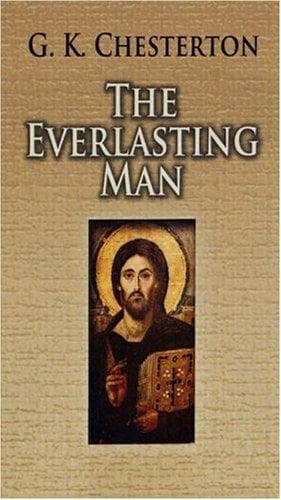
The Everlasting ManChesterton, G. K. (Gilbert Keith)
Religion
The Everlasting Man
Chesterton, G. K. (Gilbert Keith)
Catholic Church -- Apologetic works; Christianity and other religions; Religion
There are certain recognised and accepted statements in this matter
which may for brevity and convenience be described as lies. We have all
heard people say that Christianity arose in an age of barbarism. They
might just as well say that Christian Science arose in an age of
barbarism. They may think Christianity was a symptom of social decay, as
I think Christian Science a symptom of mental decay. They may think
Christianity a superstition that ultimately destroyed a civilisation, as
I think Christian Science a superstition capable (if taken seriously) of
destroying any number of civilisations. But to say that a Christian of
the fourth or fifth centuries was a barbarian living in a barbarous time
is exactly like saying that Mrs. Eddy was a Red Indian. And if I allowed
my constitutional impatience with Mrs. Eddy to impel me to call her a
Red Indian, I should incidentally be telling a lie. We may like or
dislike the imperial civilisation of Rome in the fourth century; we may
like or dislike the industrial civilisation of America in the nineteenth
century; but that they both were what we commonly mean by a civilisation
no person of common sense could deny if he wanted to. This is a very
obvious fact, but it is also a very fundamental one; and we must make it
the foundation of any further description of constructive Christianity
in the past. For good or evil, it was pre-eminently the product of a
civilised age, perhaps of an over-civilised age. This is the first fact
apart from all praise or blame; indeed I am so unfortunate as not to
feel that I praise a thing when I compare it to Christian Science. But
it is at least desirable to know something of the savour of a society in
which we are condemning or praising anything; and the science that
connects Mrs. Eddy with tomahawks or the Mater Dolorosa with totems may
for our general convenience be eliminated. The dominant fact, not merely
about the Christian religion, but about the whole pagan civilisation,
was that which has been more than once repeated in these pages. The
Mediterranean was a lake in the real sense of a pool; in which a number
of different cults or cultures were, as the phrase goes, pooled. Those
cities facing each other round the circle of the lake became more and
more one cosmopolitan culture. On its legal and military side it was the
Roman Empire; but it was very many-sided. It might be called
superstitious in the sense that it contained a great number of varied
superstitions; but by no possibility can any part of it be called
barbarous.
Public-domain text, read in full here on John Shaqi.
Reviews
Reviews
No reviews yet
Be the first to share your thoughts on this work.
Elsewhere in the archive
Join the Discussion
Join the discussion
Sign in to leave a comment or review.
Sign InorCreate an account