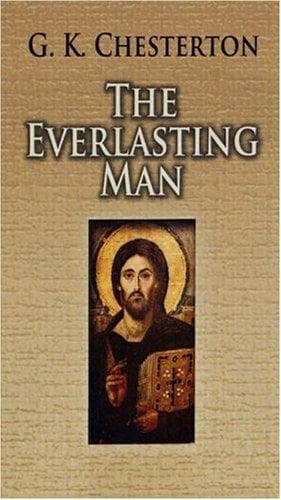
The Everlasting ManChesterton, G. K. (Gilbert Keith)
Religion
The Everlasting Man
Chesterton, G. K. (Gilbert Keith)
Catholic Church -- Apologetic works; Christianity and other religions; Religion
The modern missionary, with his palm-leaf hat and his umbrella, has
become rather a figure of fun. He is chaffed among men of the world for
the ease with which he can be eaten by cannibals and the narrow bigotry
which makes him regard the cannibal culture as lower than his own.
Perhaps the best part of the joke is that the men of the world do not
see that the joke is against themselves. It is rather ridiculous to ask
a man just about to be boiled in a pot and eaten, at a purely religious
feast, why he does not regard all religions as equally friendly and
fraternal. But there is a more subtle criticism uttered against the more
old-fashioned missionary; to the effect that he generalises too broadly
about the heathen and pays too little attention to the difference
between Mahomet and Mumbo-Jumbo. There was probably truth in this
complaint, especially in the past; but it is my main contention here
that the exaggeration is all the other way at present. It is the
temptation of the professors to treat mythologies too much as
theologies; as things thoroughly thought out and seriously held. It is
the temptation of the intellectuals to take much too seriously the fine
shades of various schools in the rather irresponsible metaphysics of
Asia. Above all, it is their temptation to miss the real truth implied
in the idea of Aquinas contra Gentiles or Athanasius contra mundum.
If the missionary says, in fact, that he is exceptional in being a
Christian, and that the rest of the races and religions can be
collectively classified as heathen, he is perfectly right. He may say
it in quite the wrong spirit, in which case he is spiritually wrong. But
in the cold light of philosophy and history, he is intellectually right.
He may not be right-minded, but he is right. He may not even have a
right to be right, but he is right. The outer world to which he brings
his creed really is something subject to certain generalisations
covering all its varieties, and is not merely a variety of similar
creeds. Perhaps it is in any case too much of a temptation to pride or
hypocrisy to call it heathenry. Perhaps it would be better simply to
call it humanity. But there are certain broad characteristics of what we
call humanity while it remains in what we call heathenry. They are not
necessarily bad characteristics; some of them are worthy of the respect
of Christendom; some of them have been absorbed and transfigured in the
substance of Christendom. But they existed before Christendom and they
still exist outside Christendom, as certainly as the sea existed before
a boat and all round a boat; and they have as strong and as universal
and as unmistakable a savour as the sea.
Public-domain text, read in full here on John Shaqi.
Reviews
Reviews
No reviews yet
Be the first to share your thoughts on this work.
Elsewhere in the archive
Join the Discussion
Join the discussion
Sign in to leave a comment or review.
Sign InorCreate an account