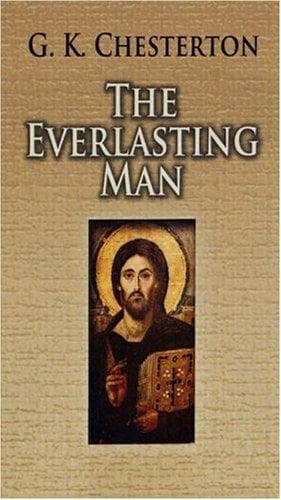
The Everlasting ManChesterton, G. K. (Gilbert Keith)
Religion
The Everlasting Man
Chesterton, G. K. (Gilbert Keith)
Catholic Church -- Apologetic works; Christianity and other religions; Religion
In this book, which is merely meant as a popular criticism of popular
fallacies, often indeed of very vulgar errors, I feel that I have
sometimes given an impression of scoffing at serious scientific work. It
was, however, the very reverse of my intention. I am not arguing with
the scientist who explains the elephant, but only with the sophist who
explains it away. And as a matter of fact the sophist plays to the
gallery, as he did in ancient Greece. He appeals to the ignorant,
especially when he appeals to the learned. But I never meant my own
criticism to be an impertinence to the truly learned. We all owe an
infinite debt to the researches, especially the recent researches, of
single-minded students in these matters; and I have only professed to
pick up things here and there from them. I have not loaded my abstract
argument with quotations and references, which only make a man look more
learned than he is; but in some cases I find that my own loose fashion
of allusion is rather misleading about my own meaning. The passage about
Chaucer and the Child Martyr is badly expressed; I only mean that the
English poet probably had in mind the English saint; of whose story he
gives a sort of foreign version. In the same way two statements in the
chapter on Mythology follow each other in such a way that it may seem to
be suggested that the second story about Monotheism refers to the
Southern Seas. I may explain that Atahocan belongs not to Australasian
but to American savages. So in the chapter called ‘The Antiquity of
Civilisation,’ which I feel to be the most unsatisfactory, I have given
my own impression of the meaning of the development of Egyptian monarchy
too much, perhaps, as if it were identical with the facts on which it
was founded, as given in works like those of Professor J. L. Myres. But
the confusion was not intentional; still less was there any intention to
imply, in the remainder of the chapter, that the anthropological
speculations about races are less valuable than they undoubtedly are. My
criticism is strictly relative; I may say that the Pyramids are plainer
than the tracks of the desert, without denying that wiser men than I may
see tracks in what is to me the trackless sand.
Public-domain text, read in full here on John Shaqi.
Reviews
Reviews
No reviews yet
Be the first to share your thoughts on this work.
Elsewhere in the archive
Join the Discussion
Join the discussion
Sign in to leave a comment or review.
Sign InorCreate an account