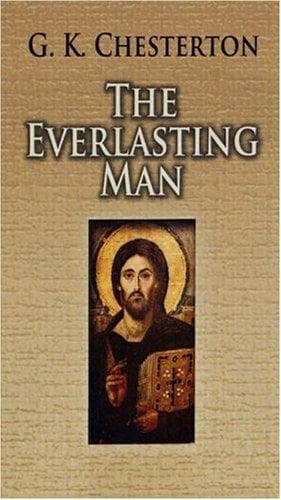
The Everlasting ManChesterton, G. K. (Gilbert Keith)
Religion
The Everlasting Man
Chesterton, G. K. (Gilbert Keith)
Catholic Church -- Apologetic works; Christianity and other religions; Religion
it is already there at the beginning of history. But as history unfolds
itself, this question of communication is clearly the main question of
these riverside communities. With the need of communication comes the
need of a common government and the growing greatness and spreading
shadow of the king. The other binding force besides the king, and
perhaps older than the king, is the priesthood; and the priesthood has
presumably even more to do with these ritual symbols and signals by
which men can communicate. And here in Egypt arose probably the primary
and certainly the typical invention to which we owe all history, and the
whole difference between the historic and the prehistoric: the
archetypal script, the art of writing.
The popular pictures of these primeval empires are not half so popular
as they might be. There is shed over them the shadow of an exaggerated
gloom, more than the normal and even healthy sadness of heathen men. It
is part of the same sort of secret pessimism that loves to make
primitive man a crawling creature, whose body is filth and whose soul is
fear. It comes of course from the fact that men are moved most by their
religion; especially when it is irreligion. For them anything primary
and elemental must be evil. But it is the curious consequence that while
we have been deluged with the wildest experiments in primitive romance,
they have all missed the real romance of being primitive. They have
described scenes that are wholly imaginary, in which the men of the
Stone Age are men of stone like walking statues; in which the Assyrians
or Egyptians are as stiff or as painted as their own most archaic art.
But none of these makers of imaginary scenes have tried to imagine what
it must really have been like to see those things as fresh which we see
as familiar. They have not seen a man discovering fire like a child
discovering fireworks. They have not seen a man playing with the
wonderful invention called the wheel, like a boy playing at putting up a
wireless station. They have never put the spirit of youth into their
descriptions of the youth of the world. It follows that amid all their
primitive or prehistoric fancies there are no jokes. There are not even
practical jokes, in connection with the practical inventions. And this
is very sharply defined in the particular case of hieroglyphics; for
there seems to be serious indication that the whole high human art of
scripture or writing began with a joke.
Public-domain text, read in full here on John Shaqi.
Reviews
Reviews
No reviews yet
Be the first to share your thoughts on this work.
Join the Discussion
Join the discussion
Sign in to leave a comment or review.
Sign InorCreate an account