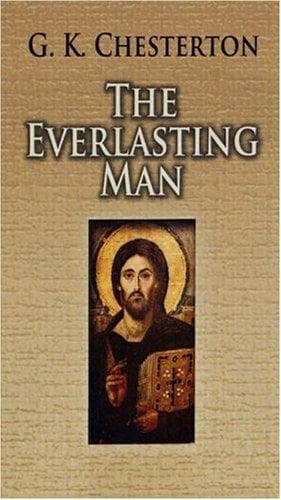
The Everlasting ManChesterton, G. K. (Gilbert Keith)
Religion
The Everlasting Man
Chesterton, G. K. (Gilbert Keith)
Catholic Church -- Apologetic works; Christianity and other religions; Religion
There is unfortunately one fallacy here into which it is very easy for
men to fall, even those who are most intelligent and perhaps especially
those who are most imaginative. It is the fallacy of supposing that
because an idea is greater in the sense of larger, therefore it is
greater in the sense of more fundamental and fixed and certain. If a man
lives alone in a straw hut in the middle of Thibet, he may be told that
he is living in the Chinese Empire; and the Chinese Empire is certainly
a splendid and spacious and impressive thing. Or alternatively he may be
told that he is living in the British Empire, and be duly impressed. But
the curious thing is that in certain mental states he can feel much more
certain about the Chinese Empire that he cannot see than about the straw
hut that he can see. He has some strange magical juggle in his mind, by
which his argument begins with the empire though his experience begins
with the hut. Sometimes he goes mad and appears to be proving that a
straw hut cannot exist in the domains of the Dragon Throne; that it is
impossible for such a civilisation as he enjoys to contain such a hovel
as he inhabits. But his insanity arises from the intellectual slip of
supposing that because China is a large and all-embracing hypothesis,
therefore it is something more than a hypothesis. Now modern people are
perpetually arguing in this way; and they extend it to things much less
real and certain than the Chinese Empire. They seem to forget, for
instance, that a man is not even certain of the Solar System as he is
certain of the South Downs. The Solar System is a deduction, and
doubtless a true deduction; but the point is that it is a very vast and
far-reaching deduction, and therefore he forgets that it is a deduction
at all and treats it as a first principle. He _might_ discover that the
whole calculation is a miscalculation; and the sun and stars and street
lamps would look exactly the same. But he has forgotten that it is a
calculation, and is almost ready to contradict the sun if it does not
fit into the Solar System. If this is a fallacy even in the case of
facts pretty well ascertained, such as the Solar System and the Chinese
Empire, it is an even more devastating fallacy in connection with
theories and other things that are not really ascertained at all. Thus
history, especially prehistoric history, has a horrible habit of
beginning with certain generalisations about races. I will not describe
the disorder and misery this inversion has produced in modern politics.
Because the race is vaguely supposed to have produced the nation, men
talk as if the nation were something vaguer than the race. Because they
have themselves invented a reason to explain a result, they almost deny
the result in order to justify the reason. They first treat a Celt as an
axiom and then treat an Irishman as an inference. And then they are
surprised that a great fighting, roaring Irishman is angry at being
treated as an inference.
Public-domain text, read in full here on John Shaqi.
Reviews
Reviews
No reviews yet
Be the first to share your thoughts on this work.
Join the Discussion
Join the discussion
Sign in to leave a comment or review.
Sign InorCreate an account