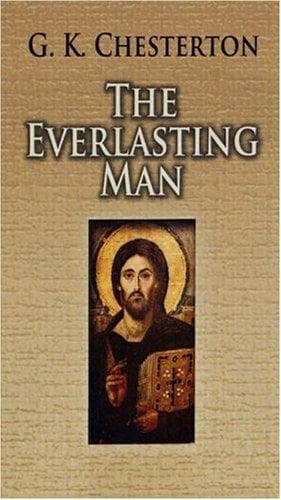
The Everlasting ManChesterton, G. K. (Gilbert Keith)
Religion
The Everlasting Man
Chesterton, G. K. (Gilbert Keith)
Catholic Church -- Apologetic works; Christianity and other religions; Religion
Every race on the face of the earth has been the subject of these
speculations, and it is impossible even to suggest an outline of the
subject. But if we take the European race alone, its history, or rather
its prehistory, has undergone many retrospective revolutions in the
short period of my own lifetime. It used to be called the Caucasian
race; and I read in childhood an account of its collision with the
Mongolian race; it was written by Bret Harte and opened with the query,
‘Or is the Caucasian played out?’ Apparently the Caucasian was played
out, for in a very short time he had been turned into the Indo-European
man; sometimes, I regret to say, proudly presented as the Indo-Germanic
man. It seems that the Hindu and the German have similar words for
mother or father; there were other similarities between Sanskrit and
various Western tongues; and with that all superficial differences
between a Hindu and a German seemed suddenly to disappear. Generally
this composite person was more conveniently described as the Aryan, and
the really important point was that he had marched westward out of those
high lands of India where fragments of his language could still be
found. When I read this as a child, I had the fancy that after all the
Aryan need not have marched westward and left his language behind him;
he might also have marched eastward and taken his language with him. If
I were to read it now, I should content myself with confessing my
ignorance of the whole matter. But as a matter of fact I have great
difficulty in reading it now, because it is not being written now. It
looks as if the Aryan is also played out. Anyhow he has not merely
changed his name but changed his address; his starting-place and his
route of travel. One new theory maintains that our race did not come to
its present home from the East but from the South. Some say the
Europeans did not come from Asia but from Africa. Some have even had the
wild idea that the Europeans came from Europe; or rather that they never
left it.
Then there is a certain amount of evidence of a more or less prehistoric
pressure from the North, such as that which seems to have brought the
Greeks to inherit the Cretan culture and so often brought the Gauls over
the hills into the fields of Italy. But I merely mention this example of
European ethnology to point out that the learned have pretty well boxed
the compass by this time; and that I, who am not one of the learned,
cannot pretend for a moment to decide where such doctors disagree. But I
can use my own common sense, and I sometimes fancy that theirs is a
little rusty from want of use. The first act of common sense is to
recognise the difference between a cloud and a mountain. And I will
affirm that nobody knows any of these things, in the sense that we all
know of the existence of the Pyramids of Egypt.
Public-domain text, read in full here on John Shaqi.
Reviews
Reviews
No reviews yet
Be the first to share your thoughts on this work.
Elsewhere in the archive
Join the Discussion
Join the discussion
Sign in to leave a comment or review.
Sign InorCreate an account