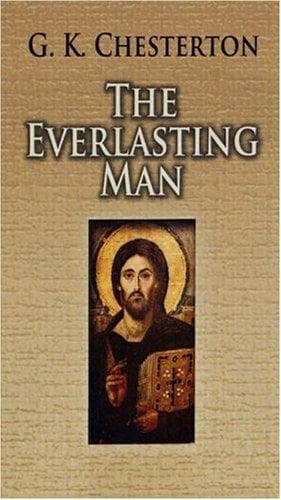
The Everlasting ManChesterton, G. K. (Gilbert Keith)
Religion
The Everlasting Man
Chesterton, G. K. (Gilbert Keith)
Catholic Church -- Apologetic works; Christianity and other religions; Religion
The truth, it may be repeated, is that what we really see, as distinct
from what we may reasonably guess, in this earliest phase of history is
darkness covering the earth and great darkness the peoples, with a light
or two gleaming here and there on chance patches of humanity; and that
two of these flames do burn upon two of these tall primeval towns; upon
the high terraces of Babylon and the huge pyramids of the Nile. There
are indeed other ancient lights, or lights that may be conjectured to be
very ancient, in very remote parts of that vast wilderness of night.
Far away to the East there is a high civilisation of vast antiquity in
China; there are the remains of civilisations in Mexico and South
America and other places, some of them apparently so high in
civilisation as to have reached the most refined forms of devil-worship.
But the difference lies in the element of tradition; the tradition of
these lost cultures has been broken off, and though the tradition of
China still lives, it is doubtful whether we know anything about it.
Moreover, a man trying to measure the Chinese antiquity has to use
Chinese traditions of measurement; and he has a strange sensation of
having passed into another world under other laws of time and space.
Time is telescoped outwards, and centuries assume the slow and stiff
movement of aeons; the white man trying to see it as the yellow man
sees, feels as if his head were turning round and wonders wildly whether
it is growing a pigtail. Anyhow he cannot take in a scientific sense
that queer perspective that leads up to the primeval pagoda of the first
of the Sons of Heaven. He is in the real antipodes; the only true
alternative world to Christendom; and he is after a fashion walking
upside down. I have spoken of the medieval map-maker and his dragon; but
what medieval traveller, however much interested in monsters, would
expect to find a country where a dragon is a benevolent and amiable
being? Of the more serious side of Chinese tradition something will be
said in another connection; but here I am only talking of tradition and
the test of antiquity. And I only mention China as an antiquity that is
not for us reached by a bridge of tradition; and Babylon and Egypt as
antiquities that are. Herodotus is a human being, in a sense in which a
Chinaman in a billycock hat, sitting opposite to us in a London
tea-shop, is hardly human. We feel as if we knew what David and Isaiah
felt like, in a way in which we never were quite certain what Li Hung
Chang felt like. The very sins that snatched away Helen or Bathsheba
have passed into a proverb of private human weakness, of pathos and even
of pardon. The very virtues of the Chinaman have about them something
terrifying. This is the difference made by the destruction or
preservation of a continuous historical inheritance; as from ancient
Egypt to modern Europe. But when we ask what was that world that we
inherit, and why those particular people and places seem to belong to
Public-domain text, read in full here on John Shaqi.
Reviews
Reviews
No reviews yet
Be the first to share your thoughts on this work.
Elsewhere in the archive
Join the Discussion
Join the discussion
Sign in to leave a comment or review.
Sign InorCreate an account