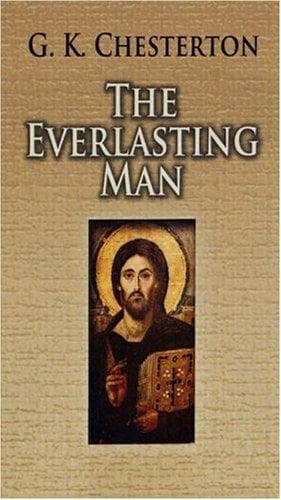
The Everlasting ManChesterton, G. K. (Gilbert Keith)
Religion
The Everlasting Man
Chesterton, G. K. (Gilbert Keith)
Catholic Church -- Apologetic works; Christianity and other religions; Religion
In this sketch of religious history, with all decent deference to men
much more learned than myself, I propose to cut across and disregard
this modern method of classification, which I feel sure has falsified
the facts of history. I shall here submit an alternative classification
of religion or religions, which I believe would be found to cover all
the facts and, what is quite as important here, all the fancies. Instead
of dividing religion geographically, and as it were vertically, into
Christian, Moslem, Brahmin, Buddhist, and so on, I would divide it
psychologically and in some sense horizontally; into the strata of
spiritual elements and influences that could sometimes exist in the same
country, or even in the same man. Putting the Church apart for the
moment, I should be disposed to divide the natural religion of the mass
of mankind under such headings as these: God; the Gods; the Demons; the
Philosophers. I believe some such classification will help us to sort
out the spiritual experiences of men much more successfully than the
conventional business of comparing religions; and that many famous
figures will naturally fall into their place in this way who are only
forced into their place in the other. As I shall make use of these
titles or terms more than once in narrative and allusion, it will be
well to define at this stage for what I mean them to stand. And I will
begin with the first, the simplest and the most sublime, in this
chapter.
In considering the elements of pagan humanity, we must begin by an
attempt to describe the indescribable. Many get over the difficulty of
describing it by the expedient of denying it, or at least ignoring it;
but the whole point of it is that it was something that was never quite
eliminated even when it was ignored. They are obsessed by their
evolutionary monomania that every great thing grows from a seed, or
something smaller than itself. They seem to forget that every seed comes
from a tree, or from something larger than itself. Now there is very
good ground for guessing that religion did not originally come from some
detail that was forgotten because it was too small to be traced. Much
more probably it was an idea that was abandoned because it was too large
to be managed. There is very good reason to suppose that many people did
begin with the simple but overwhelming idea of one God who governs all;
and afterwards fell away into such things as demon-worship almost as a
sort of secret dissipation. Even the test of savage beliefs, of which
the folk-lore students are so fond, is admittedly often found to support
such a view. Some of the very rudest savages, primitive in every sense
in which anthropologists use the word, the Australian aborigines for
instance, are found to have a pure monotheism with a high moral tone. A
missionary was preaching to a very wild tribe of polytheists, who had
told him all their polytheistic tales, and telling them in return of the
Public-domain text, read in full here on John Shaqi.
Reviews
Reviews
No reviews yet
Be the first to share your thoughts on this work.
Elsewhere in the archive
Join the Discussion
Join the discussion
Sign in to leave a comment or review.
Sign InorCreate an account