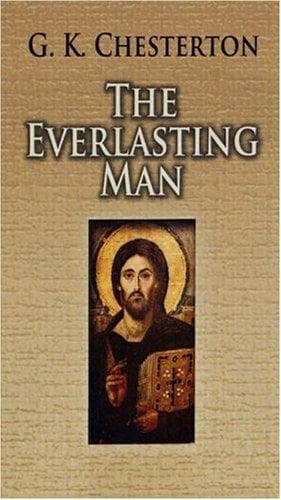
The Everlasting ManChesterton, G. K. (Gilbert Keith)
Religion
The Everlasting Man
Chesterton, G. K. (Gilbert Keith)
Catholic Church -- Apologetic works; Christianity and other religions; Religion
What are here called the Gods might almost alternatively be called the
Day-Dreams. To compare them to dreams is not to deny that dreams can
come true. To compare them to travellers’ tales is not to deny that they
may be true tales, or at least truthful tales. In truth they are the
sort of tales the traveller tells to himself. All this mythological
business belongs to the poetical part of men. It seems strangely
forgotten nowadays that a myth is a work of imagination and therefore a
work of art. It needs a poet to make it. It needs a poet to criticise
it. There are more poets than non-poets in the world, as is proved by
the popular origin of such legends. But for some reason I have never
heard explained, it is only the minority of unpoetical people who are
allowed to write critical studies of these popular poems. We do not
submit a sonnet to a mathematician or a song to a calculating boy; but
we do indulge the equally fantastic idea that folk-lore can be treated
as a science. Unless these things are appreciated artistically they are
not appreciated at all. When the professor is told by the barbarian that
once there was nothing except a great feathered serpent, unless the
learned man feels a thrill and a half temptation to wish it were true,
he is no judge of such things at all. When he is assured, on the best
Red Indian authority, that a primitive hero carried the sun and moon and
stars in a box, unless he claps his hands and almost kicks his legs as a
child would at such a charming fancy, he knows nothing about the matter.
This test is not nonsensical; primitive children and barbaric children
do laugh and kick like other children; and we must have a certain
simplicity to repicture the childhood of the world. When Hiawatha was
told by his nurse that a warrior threw his grandmother up to the moon,
he laughed like any English child told by his nurse that a cow jumped
over the moon. The child sees the joke as well as most men, and better
than some scientific men. But the ultimate test even of the fantastic is
the appropriateness of the inappropriate. And the test must appear
merely arbitrary because it is merely artistic. If any student tells me
that the infant Hiawatha only laughed out of respect for the tribal
custom of sacrificing the aged to economical housekeeping, I say he did
not. If any scholar tells me that the cow jumped over the moon only
because a heifer was sacrificed to Diana, I answer that it did not. It
happened because it is obviously the right thing for a cow to jump over
the moon. Mythology is a lost art, one of the few arts that really are
lost; but it is an art. The horned moon and the horned mooncalf make a
harmonious and almost a quiet pattern. And throwing your grandmother
into the sky is not good behaviour; but it is perfectly good taste.
Public-domain text, read in full here on John Shaqi.
Reviews
Reviews
No reviews yet
Be the first to share your thoughts on this work.
Elsewhere in the archive
Join the Discussion
Join the discussion
Sign in to leave a comment or review.
Sign InorCreate an account