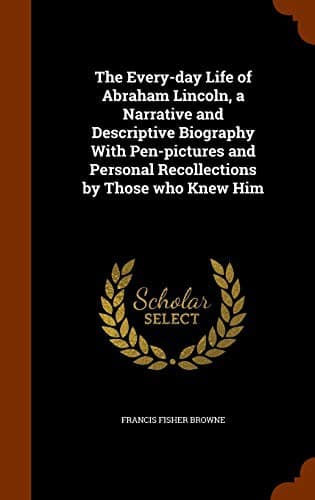
The Every-day Life of Abraham Lincoln: A Narrative And Descriptive Biography With Pen-Pictures And Personal; Recollections By Those Who Knew HimBrowne, Francis F. (Francis Fisher)
History
The Every-day Life of Abraham Lincoln: A Narrative And Descriptive Biography With Pen-Pictures And Personal; Recollections By Those Who Knew Him
Browne, Francis F. (Francis Fisher)
Lincoln, Abraham, 1809-1865; Presidents -- United States -- Biography
The preceding incident leads to another, in which Lincoln himself
figures as a horse-trader. The scene is a very humorous one; and, as
usual in an encounter of wit, Lincoln came out ahead. He and a certain
Judge once got to bantering each other about trading horses; and it was
agreed that the next morning at nine o'clock they should make a trade,
the horses to be unseen up to that hour,--and no backing out, under a
forfeit of twenty-five dollars. At the hour appointed the Judge came up,
leading the sorriest looking specimen of a nag ever seen in those parts.
In a few minutes Lincoln was seen approaching with a _wooden saw-horse_
upon his shoulders. Great were the shouts and the laughter of the crowd;
and these increased, when Lincoln, surveying the Judge's animal, set
down his saw-horse, and exclaimed: "Well, Judge, this is the first time
I ever _got the worst of it_ in a horse-trade!"
There has been much discussion as to Lincoln's rank and ability as a
lawyer. Opinion among his contemporaries seems to have been somewhat
divided. Mr. Herndon felt warranted in saying that he was at the same
time a very great and a very insignificant lawyer. His mind was logical
and direct. Generalities and platitudes had no charm for him. He had the
ability to seize the strong points of a case and present them with
clearness and compactness. His power of comparison was great. He rarely
failed in a legal discussion to use this mode of reasoning. Yet he knew
practically nothing of the rules of evidence, of pleading, of practice,
as laid down in the text-books, and seemed to care little about them.
Sometimes he lost cases of the plainest justice which the most
inexperienced lawyer could have won. He looked upon two things as
essential to his success in a case. One was time; he was slow in
reasoning and slow in speech. The other was confidence that the cause he
represented was just. "If either of these were lacking," said Mr.
Herndon, "Lincoln was the weakest man at the bar. When it fell to him to
address the jury he often relied absolutely on the inspiration of the
moment,--but he seldom failed to carry his point."
Among the great number of opinions of Lincoln's rank as a lawyer,
expressed by his professional brethren, a few may properly be given in
closing this chapter, which is devoted chiefly to Mr. Lincoln's
professional career. First we may quote the brief but emphatic words of
the distinguished jurist, Judge Sidney Breese, Chief Justice of
Illinois, who said: "For my single self, I have for a quarter of a
century regarded Mr. Lincoln as the finest lawyer I ever knew, and of a
professional bearing so high-toned and honorable, as justly, and without
derogating from the claims of others, entitling him to be presented to
the profession as a model well worthy of the closest imitation."
Public-domain text, read in full here on John Shaqi.
Reviews
Reviews
No reviews yet
Be the first to share your thoughts on this work.
Elsewhere in the archive
Join the Discussion
Join the discussion
Sign in to leave a comment or review.
Sign InorCreate an account