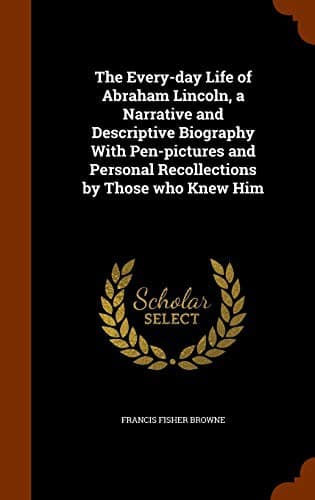
The Every-day Life of Abraham Lincoln: A Narrative And Descriptive Biography With Pen-Pictures And Personal; Recollections By Those Who Knew HimBrowne, Francis F. (Francis Fisher)
History
The Every-day Life of Abraham Lincoln: A Narrative And Descriptive Biography With Pen-Pictures And Personal; Recollections By Those Who Knew Him
Browne, Francis F. (Francis Fisher)
Lincoln, Abraham, 1809-1865; Presidents -- United States -- Biography
The Hon. Thomas Drummond, for many years Judge of the United States
District Court at Chicago, said: "It is not necessary to claim for Mr.
Lincoln attributes or qualities which he did not possess. He had enough
to entitle him to the love and respect and esteem of all who knew him.
He was not skilled in the learning of the schools, and his knowledge of
the law was acquired almost entirely by his own unaided study and by the
practice of his profession. Nature gave him great clearness and
acuteness of intellect and a vast fund of common-sense; and as a
consequence of these he had much sagacity in judging of the motives and
springs of human conduct. With a voice by no means pleasing, and,
indeed, when excited, in its shrill tones sometimes almost disagreeable;
without any of the personal graces of the orator; without much in the
outward man indicating superiority of intellect; without great quickness
of perception,--still, his mind was so vigorous, his comprehension so
exact and clear, and his judgments so sure, that he easily mastered the
intricacies of his profession, and became one of the ablest reasoners
and most impressive speakers at our bar. With a probity of character
known to all, with an intuitive insight into the human heart, with a
clearness of statement which was itself an argument, with an uncommon
power and facility of illustration, often, it is true, of a plain and
homely kind, and with that sincerity and earnestness of manner to carry
conviction, he was perhaps one of the most successful jury lawyers we
have ever had in the State. He always tried a case fairly and honestly.
He never intentionally misrepresented the testimony of a witness or the
arguments of an opponent. He met both squarely, and, if he could not
explain the one or answer the other, substantially admitted it. He never
misstated the law according to his own intelligent view of it. Such was
the transparent candor and integrity of his nature that he could not
well or strongly argue a side or a cause that he thought wrong. Of
course, he felt it his duty to say what could be said, and to leave the
decision to others; but there could be seen in such cases the inward
struggle in his own mind. In trying a cause he might occasionally dwell
too long or give too much importance to an inconsiderable point; but
this was the exception, and generally he went straight to the citadel of
a cause or a question, and struck home there, knowing if that were won
the outwork would necessarily fall. He could hardly be called very
learned in his profession, and yet he rarely tried a cause without fully
understanding the law applicable to it. I have no hesitation in saying
he was one of the ablest lawyers I have ever known. If he was forcible
before the jury he was equally so with the court. He detected with
unerring sagacity the marked points of his opponents' arguments, and
pressed his own views with overwhelming force. His efforts were quite
Public-domain text, read in full here on John Shaqi.
Reviews
Reviews
No reviews yet
Be the first to share your thoughts on this work.
Elsewhere in the archive
Join the Discussion
Join the discussion
Sign in to leave a comment or review.
Sign InorCreate an account