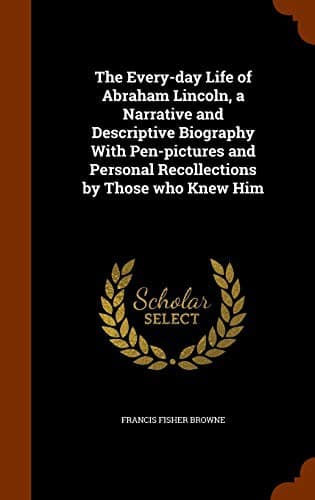
The Every-day Life of Abraham Lincoln: A Narrative And Descriptive Biography With Pen-Pictures And Personal; Recollections By Those Who Knew HimBrowne, Francis F. (Francis Fisher)
History
The Every-day Life of Abraham Lincoln: A Narrative And Descriptive Biography With Pen-Pictures And Personal; Recollections By Those Who Knew Him
Browne, Francis F. (Francis Fisher)
Lincoln, Abraham, 1809-1865; Presidents -- United States -- Biography
While in Congress, Lincoln had declared himself plainly as opposed to
slavery; and in public speeches not less than private conversations he
had not hesitated to express his convictions on the subject. In 1850 he
said to Major Stuart: "The time will soon come when we must all be
Democrats or Abolitionists. When that time comes, _my mind is made up_.
The slavery question cannot be compromised." The hour had now struck in
which Lincoln was to espouse with his whole heart and soul that cause
for which finally he was to lay down his life. In the language of Mr.
Arnold, "He had bided his time. He had waited until the harvest was
ripe. With unerring sagacity he realized that the triumph of freedom was
at hand. He entered upon the conflict with the deepest conviction that
the perpetuity of the Republic required the extinction of slavery. So,
adopting as his motto, 'A house divided against itself cannot stand,' he
girded himself for the contest. The years from 1854 to 1860 were on his
part years of constant, active, and unwearied effort. His position in
the State of Illinois was central and commanding. He was now to become
the recognized leader of the anti-slavery party in the Northwest, and in
all the Valley of the Mississippi. Lincoln was a practical statesman,
never attempting the impossible, but seeking to do the best thing
practicable under existing circumstances. He knew that prohibition in
the territories would result in no more slave states and no slave
territory. And now, when the repeal of the Missouri Compromise shattered
all parties into fragments, he came forward to build up the Free Soil
party and threw into the conflict all his strength and vigor. The
conviction of his duty was deep and sincere. Hence he pleaded the cause
of liberty with an energy, ability, and power which rapidly gained for
him a national reputation. Conscious of the greatness of his cause,
inspired by a genuine love of liberty, animated and made strong by the
moral sublimity of the conflict, he solemnly announced his determination
to speak for freedom and against slavery until--in his own
words--wherever the Federal Government has power, 'the sun shall shine,
the rain shall fall, and the wind shall blow upon no man who goes forth
to unrequited toil.'"
The absorbing political topic in 1855 was the contest in Kansas, which
proved the battle-ground for the struggle over the introduction of
slavery into the territories north of the line established by the
"Missouri Compromise." Lincoln's views on the subject are defined in a
notable letter to his friend Joshua Speed, a resident of Kentucky. The
following passages show, in Lincoln's own words, where he stood on the
slavery question at this memorable epoch:
SPRINGFIELD, AUGUST 24, 1855.
Public-domain text, read in full here on John Shaqi.
Reviews
Reviews
No reviews yet
Be the first to share your thoughts on this work.
Elsewhere in the archive
Join the Discussion
Join the discussion
Sign in to leave a comment or review.
Sign InorCreate an account