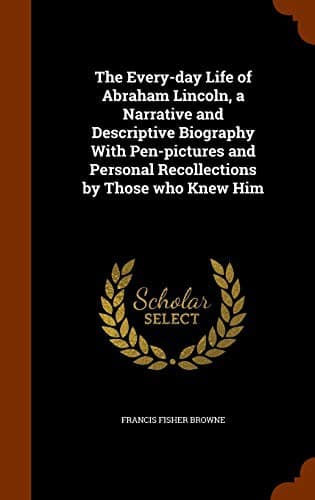
The Every-day Life of Abraham Lincoln: A Narrative And Descriptive Biography With Pen-Pictures And Personal; Recollections By Those Who Knew HimBrowne, Francis F. (Francis Fisher)
History
The Every-day Life of Abraham Lincoln: A Narrative And Descriptive Biography With Pen-Pictures And Personal; Recollections By Those Who Knew Him
Browne, Francis F. (Francis Fisher)
Lincoln, Abraham, 1809-1865; Presidents -- United States -- Biography
Some interesting recollections of the events of this stirring period,
and of Lincoln's part in them, are given by Mr. Paul Selby, for a long
time editor of the "State Journal" at Springfield, and one of
Lincoln's old-time friends and political associates. "While Abraham
Lincoln had the reputation of being inspired by an almost unbounded
ambition," says Mr. Selby, "it was of that generous quality which
characterized his other attributes, and often led him voluntarily to
restrain its gratification in deference to the conflicting aspirations
of his friends. All remember his magnanimity towards Col. Edward D.
Baker, when the latter was elected to Congress from the Springfield
District in 1844, and the frankness with which he informed Baker of
his own desire to be a candidate in 1846--when for the only time in
his life, he was elected to that body. In 1852, Richard Yates of
Jacksonville, then recognized as one of the rising young orators and
statesmen of the West, was elected to Congress for the second time
from the Springfield District. It was during the term following this
election that the Kansas-Nebraska issue was precipitated upon the
country by Senator Douglas, in the introduction of his bill for the
repeal of the Missouri Compromise. Yates, in obedience to his
impulses, which were always on the side of freedom, took strong ground
against the measure--notwithstanding the fact that a majority of his
constituents, though originally Whigs, were strongly conservative, as
was generally the case with people who were largely of Kentucky and
Tennessee origin. In 1854 the Whig party, which had been divided on
the Kansas-Nebraska question, began to manifest symptoms of
disintegration; while the Republican party, though not yet known by
that name, began to take form. At this time I was publishing a paper
at Jacksonville, Yates's home; and although from the date of my
connection with it, in 1852, it had not been a political paper, the
introduction of a new issue soon led me to take decided ground on the
side of free territory. Lincoln at once sprang into prominence as one
of the boldest, most vigorous and eloquent opponents of Mr. Douglas's
measure, which was construed as a scheme to secure the admission of
slavery into all the new territories of the United States. At that
time Lincoln's election to a seat in Congress would probably have been
very grateful to his ambition, as well as acceptable in a pecuniary
point of view; and his prominence and ability had already attracted
the eyes of the whole State toward him in a special degree. Having
occasion to visit Springfield one day while the subject of the
selection of a candidate was under consideration among the opponents
of the Kansas-Nebraska Bill, I encountered Mr. Lincoln on the street.
As we walked along, the subject of the choice of a candidate for
Congress to succeed Yates came up, when I stated that many of the
old-line Whigs and anti-Nebraska men in the western part of the
Public-domain text, read in full here on John Shaqi.
Reviews
Reviews
No reviews yet
Be the first to share your thoughts on this work.
Elsewhere in the archive
Join the Discussion
Join the discussion
Sign in to leave a comment or review.
Sign InorCreate an account