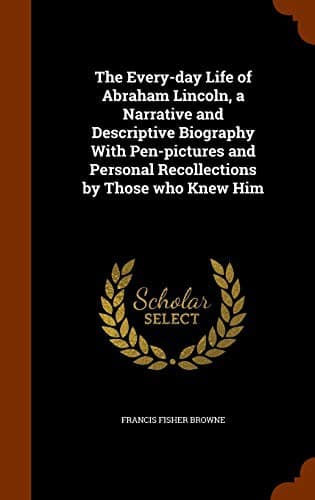
The Every-day Life of Abraham Lincoln: A Narrative And Descriptive Biography With Pen-Pictures And Personal; Recollections By Those Who Knew HimBrowne, Francis F. (Francis Fisher)
History
The Every-day Life of Abraham Lincoln: A Narrative And Descriptive Biography With Pen-Pictures And Personal; Recollections By Those Who Knew Him
Browne, Francis F. (Francis Fisher)
Lincoln, Abraham, 1809-1865; Presidents -- United States -- Biography
had given him one of the books from which they sang. He began to read a
piece with all the earnestness of his great, earnest soul. In the middle
of the second verse his friend 'Jim' felt a choking in his throat and a
tickling in his nose. At the beginning of the third verse he saw that
the stranger was weeping, and his own tears fell fast. Turning toward
Lincoln, who was reading straight on, he saw the great blinding tears in
his eyes, so that he could not possibly see the pages. He was repeating
that little song from memory. How often he had read it, or how long its
sweet and simple accents continued to reverberate through his soul, no
one can know."
CHAPTER XIII
Looking Towards the Presidency--The Illinois Republican Convention
of 1860--A "Send-Off" for Lincoln--The National Republican
Convention at Chicago--Contract of the Leading Candidates--Lincoln
Nominated--Scenes at the Convention--Sketches by
Eye-Witnesses--Lincoln Hearing the News--The Scene at
Springfield--A Visit to Lincoln at His Home--Recollections of a
Distinguished Sculptor--Receiving the Committee of the
Convention--Nomination of Douglas--Campaign of 1860--Various
Campaign Reminiscences--Lincoln and the Tall Southerner--The Vote
of the Springfield Clergy--A Graceful Letter to the Poet
Bryant--"Looking up Hard Spots."
In the latter part of the year 1859, after Lincoln had gained
considerable national prominence through events already briefly
narrated, some of his friends began to consider the expediency of
bringing him forward as a candidate for the Presidency in 1860. The
young Republican party had thus far been in the minority, and the
necessity was generally felt of nominating a man who would not render
himself objectionable by advocating extreme or unpopular measures. The
subject was mentioned to Lincoln, but he seems not to have taken it very
seriously. He said that there were distinguished men in the party who
were more worthy of the nomination, and whose public services entitled
them to it. Toward spring in 1860 Lincoln consented to a conference on
the subject with some of his more intimate friends. The meeting took
place in a committee-room in the State House. Mr. Bushnell, Mr. Hatch
(then Secretary of State), Mr. Judd (Chairman of the Republican State
Central Committee), Mr. Peck, and Mr. Grimshaw were present. They were
unanimous in opinion as to the expediency and propriety of making
Lincoln a candidate. But he was still reluctant; he doubted that he
could get the nomination even if he wished it, and asked until the next
morning to consider the matter. The next day he authorized his friends
to work for him, if they so desired, as a candidate for the Presidency,
at the National Republican convention to be held in May at Chicago.
Public-domain text, read in full here on John Shaqi.
Reviews
Reviews
No reviews yet
Be the first to share your thoughts on this work.
Elsewhere in the archive
Join the Discussion
Join the discussion
Sign in to leave a comment or review.
Sign InorCreate an account