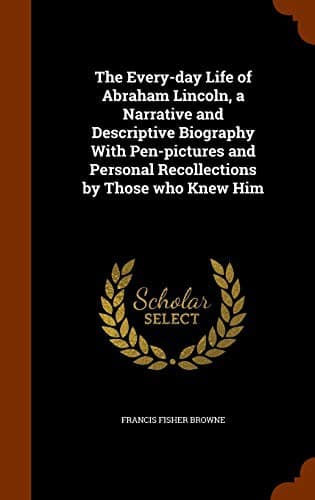
The Every-day Life of Abraham Lincoln: A Narrative And Descriptive Biography With Pen-Pictures And Personal; Recollections By Those Who Knew HimBrowne, Francis F. (Francis Fisher)
History
The Every-day Life of Abraham Lincoln: A Narrative And Descriptive Biography With Pen-Pictures And Personal; Recollections By Those Who Knew Him
Browne, Francis F. (Francis Fisher)
Lincoln, Abraham, 1809-1865; Presidents -- United States -- Biography
In June Mr. Douglas was nominated for the Presidency by the Democratic
convention, which met at Baltimore on the 18th. Mr. Douglas made a
personal canvass, speaking in most of the states, North and South, and
exerting all the powers of which he was master to win success. The
campaign, as Mr. Arnold states, "has had no parallel. The enthusiasm of
the people was like a great conflagration, like a prairie fire before a
wild tornado. A little more than twenty years had passed since Owen
Lovejoy, brother of Elijah Lovejoy, on the bank of the Mississippi,
kneeling on the turf not then green over the grave of the brother who
had been killed for his fidelity to freedom, had sworn eternal war
against slavery. From that time on, he and his associate Abolitionists
had gone forth preaching their crusade against oppression, with hearts
of fire and tongues of lightning; and now the consummation was to be
realized of a President elected on the distinct ground of opposition to
the extension of slavery. For years the hatred of that institution had
been growing and gathering force. Whittier, Bryant, Lowell, Longfellow,
and others, had written the lyrics of liberty; the graphic pen of Mrs.
Stowe, in 'Uncle Tom's Cabin,' had painted the cruelties of the overseer
and the slaveholder; but the acts of slaveholders themselves did more to
promote the growth of anti-slavery than all other causes. The
persecutions of Abolitionists in the South; the harshness and cruelty
attending the execution of the fugitive laws; the brutality of Brooks in
knocking down, on the floor of the Senate, Charles Sumner, for words
spoken in debate: these and many other outrages had fired the hearts of
the people of the free States against this barbarous institution.
Beecher, Phillips, Channing, Sumner, and Seward, with their eloquence;
Chase with his logic; Lincoln, with his appeals to the principles of the
Declaration of Independence, and to the opinions of the founders of the
republic, his clear statements, his apt illustrations, and, above all,
his wise moderation,--all had swelled the voice of the people, which
found expression through the ballot-box, and which declared that slavery
should go no further."
Public-domain text, read in full here on John Shaqi.
Reviews
Reviews
No reviews yet
Be the first to share your thoughts on this work.
Elsewhere in the archive
Join the Discussion
Join the discussion
Sign in to leave a comment or review.
Sign InorCreate an account