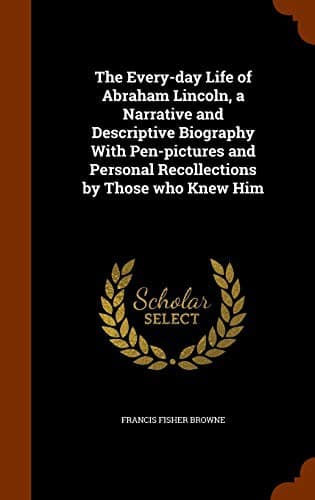
The Every-day Life of Abraham Lincoln: A Narrative And Descriptive Biography With Pen-Pictures And Personal; Recollections By Those Who Knew HimBrowne, Francis F. (Francis Fisher)
History
The Every-day Life of Abraham Lincoln: A Narrative And Descriptive Biography With Pen-Pictures And Personal; Recollections By Those Who Knew Him
Browne, Francis F. (Francis Fisher)
Lincoln, Abraham, 1809-1865; Presidents -- United States -- Biography
And when you subtracts things, when if
you have two things and you takes one away, only one remains." "Is dat
'rithmetic?" "Yah." "Well, 'tain't true, den. It's no good!" Here a
dispute arose, when Jim said, "Now, you 'spose three pigeons sit on that
fence, and somebody shoot one of dem; do t'other two stay dar? I guess
not! dey flies away quickern odder feller falls." And, Professor,
trifling as the story seems, it illustrates the arithmetic you must use
in estimating the actual losses resulting from our great battles. The
statements you have referred to give the killed, wounded, and missing at
the first roll-call after the battle, which always exhibits a greatly
exaggerated total, especially in the column of missing.'"
Mr. Goldwin Smith, the gentleman referred to in the foregoing anecdote,
has summarized his impressions of Lincoln in the following paragraph:
"Such a person as Abraham Lincoln is quite unknown to our official
circles or to those of Continental nations. Indeed, I think his place in
history will be unique. He has not been trained to diplomacy or
administrative affairs, and is in all respects one of the people. But
how wonderfully he is endowed and equipped for the performance of the
duties of the chief executive officer of the United States at this time!
The precision and minuteness of his information on all questions to
which we referred was a succession of surprises to me."
Still terser, but hardly less expressive, is Emerson's characterization
of Lincoln as one who had been "permitted to do more for America than
any other American man."
A striking passage by Mr. Norman Hapgood should have place among these
tributes. "Lincoln had no artificial aids. He merely proved the weapon
of finest temper in the fire in which he was tested. In the struggle for
survival in a national upheaval, he not only proved the living power of
integrity and elasticity, but he easily combined with his feats of
strength and shrewdness some of the highest flights of taste. As we look
back across the changes of his life,--see him passing over the high
places and the low, and across the long stretches of the prairie;
spending years in the Socratic arguments of the tavern, and anon holding
the rudder of state in grim silence; choosing jests which have the
freshness of earth, and principles of eternal right; judging potentates
and laborers in the clear light of nature, and at ease with both; alone
by virtue of a large and melancholy soul, at home with every man by
virtue of love and faith,--this figure takes its place high in our minds
and hearts, not solely through the natural right of strength and
success, but also because his strength is ours, and the success won by
him rested on the fundamental purity and health of the popular will of
which he was the leader and the servant. Abraham Lincoln was in a deep
and lasting sense the first American."
Public-domain text, read in full here on John Shaqi.
Reviews
Reviews
No reviews yet
Be the first to share your thoughts on this work.
Elsewhere in the archive
Join the Discussion
Join the discussion
Sign in to leave a comment or review.
Sign InorCreate an account