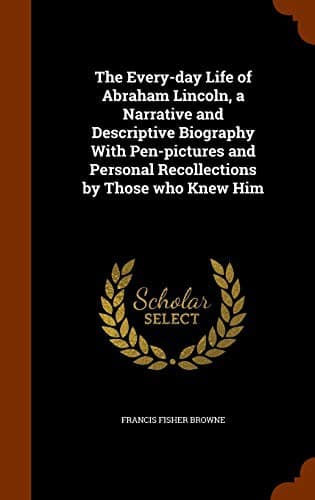
The Every-day Life of Abraham Lincoln: A Narrative And Descriptive Biography With Pen-Pictures And Personal; Recollections By Those Who Knew HimBrowne, Francis F. (Francis Fisher)
History
The Every-day Life of Abraham Lincoln: A Narrative And Descriptive Biography With Pen-Pictures And Personal; Recollections By Those Who Knew Him
Browne, Francis F. (Francis Fisher)
Lincoln, Abraham, 1809-1865; Presidents -- United States -- Biography
For two years after the Presidential contest between Clay and Polk,
Lincoln devoted himself assiduously to his law practice. But in 1846 he
was again active in politics, this time striving for a seat in the
National Congress. His chief opponent among the Whig candidates was his
old friend John J. Hardin, who soon withdrew from the contest, leaving
Mr. Lincoln alone in the field. The candidate on the Democratic ticket
was Peter Cartwright, the famous Methodist preacher. It was supposed
from his great popularity as a pulpit orator that Mr. Cartwright would
run far ahead of his ticket. Instead of this, Lincoln received a
majority of 1,511 in his district, which in 1844 had given Clay a
majority of only 914 and in 1848 had allowed the Whig candidate for
Congress to be defeated by 106 votes.
Lincoln took his seat in the Thirtieth Congress in December, 1847, the
only Whig member from Illinois. Among the notable members of this
Congress were ex-president John Quincy Adams; Andrew Johnson, elected
Vice-President with Lincoln on his second election; A.H. Stephens,
afterwards Vice-President of the Confederacy; Toombs, Rhett, Cobb, and
others who afterwards became leaders of the Rebellion. In the Senate
were Daniel Webster, Simon Cameron, Lewis Cass, Mason, Hunter, John C.
Calhoun, and Jefferson Davis.
Lincoln entered Congress as the Illinois leader of the Whig party. He
was reputed to be an able and effective speaker. In speaking of the
impression he made upon his associates, the Hon. Robert C. Winthrop
says: "I recall vividly the impressions I then formed both of his
ability and amiability. We were old Whigs together, and agreed entirely
upon all questions of public interest. I could not always concur in the
policy of the party which made him President, but I never lost my
personal regard for him. For shrewdness, sagacity, and keen practical
sense, he has had no superior in our day or generation."
Alexander H. Stephens, writing seventeen years after Lincoln's death,
recalled their service together in Congress. "I knew Mr. Lincoln well
and intimately," said Mr. Stephens. "We both were ardent supporters of
General Taylor for President in 1848. Lincoln, Toombs, Preston, myself,
and others, formed the first Congressional Taylor Club, known as 'The
Young Indians,' and organized the Taylor movement which resulted in his
nomination. Mr. Lincoln was careless as to his manners and awkward in
his speech, but possessed a strong, clear, vigorous mind. He always
attracted and riveted the attention of the House when he spoke. His
manner of speech as well as of thought was original. He had no model. He
was a man of strong convictions, and what Carlyle would have called an
_earnest_ man. He abounded in anecdote. He illustrated everything he
was talking about by an anecdote, always exceedingly apt and pointed;
and socially he always kept his company in a roar of laughter."
Public-domain text, read in full here on John Shaqi.
Reviews
Reviews
No reviews yet
Be the first to share your thoughts on this work.
Elsewhere in the archive
Join the Discussion
Join the discussion
Sign in to leave a comment or review.
Sign InorCreate an account