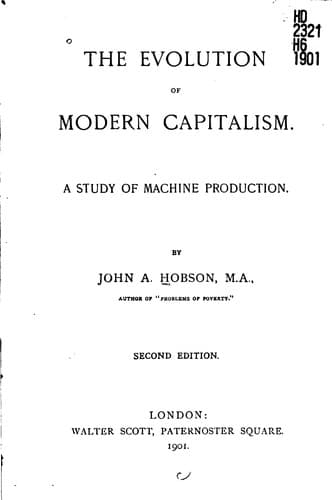
The Evolution of Modern Capitalism: A Study of Machine ProductionHobson, J. A. (John Atkinson)
History
The Evolution of Modern Capitalism: A Study of Machine Production
Hobson, J. A. (John Atkinson)
Capitalism; Industries -- History; Machinery in the workplace
As the field of competition is narrowed to a comparatively few large
competitors, there arises a double inducement to suspend or mitigate
hostilities; as the competition is fiercer more is gained by a truce;
as the number of combatants is smaller, a truce can be more easily
formed and maintained. In most machine-using countries each branch of
a staple industry endeavours to protect itself from free competition
by a combination of masters to fix a scale of prices. This is the
normal condition of trade in England to-day. These combinations to fix
and maintain prices are not equally successful in all trades, but they
are always operative to a more or less extent in modifying or
retarding the effects of competition. Where trade unions of operatives
are strong, well-informed, and resolute, or where outsiders have large
facilities for investing capital and dividing the trade, the
endeavours to maintain prices and to secure a higher than the
competitive rate of profits are unsuccessful. The joint operation of
both these conditions in the cotton-spinning trade explains why the
Lancashire spinners have been unable to check the effects of
cut-throat competition. But throughout all branches of textile, metal,
pottery, engineering, and machine-making trades strong and persistent
endeavours are made by co-operative action of capitalists to limit
competition by fixing a scale of prices which should not be underbid.
Where competing railways fix a tariff of rates for carriage, or
competing manufacturers fix a scale of prices for their goods, their
object is to secure to themselves in higher profits a portion or the
whole of the productive and competitive economies attending
large-scale production, instead of allowing them by unrestricted
competition to pass into the hands of their customers. Suppose that a
number of steel rail manufacturers freely competing would drive down
the selling price to £1 a ton, but that by a trade agreement they
maintain £1 10s. as the minimum price, 10s. per ton represents the
economies of production which they divert from their customers into
their own possession by a limitation of the competition. Part of the
10s. may represent the actual saving of the labour which would have
been spent in competition as prices fell from £1 10s. to £1. Part may
represent a taking in higher profits of some of the economies of new
machinery or improved methods of production common to the competing
firms, and which would inevitably have led to a fall of price if the
competitive process had been allowed free play.
Public-domain text, read in full here on John Shaqi.
Reviews
Reviews
No reviews yet
Be the first to share your thoughts on this work.
Elsewhere in the archive
Join the Discussion
Join the discussion
Sign in to leave a comment or review.
Sign InorCreate an account