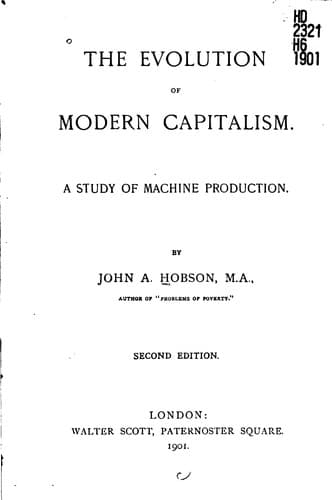
The Evolution of Modern Capitalism: A Study of Machine ProductionHobson, J. A. (John Atkinson)
History
The Evolution of Modern Capitalism: A Study of Machine Production
Hobson, J. A. (John Atkinson)
Capitalism; Industries -- History; Machinery in the workplace
It is commonly said by English writers upon economics that the state
of over-production, the redundancy of capital and labour, though found
in one or two or several trades at the same time, cannot be of general
application. If too much capital and labour is engaged in one industry
there is, they argue, too little in another, there cannot be at the
same time a general state of over-production. Now if by general
over-production is meant not that every single industry is supplied
with an excess of capital, but that there exists a net over-supply,
taking into account the plethora in some trades and the deficiency in
others, this assertion of English economists is not in accordance with
ascertained facts or with the authority of economists outside of
England.
§ 3. If a depression of trade signified a misapplication of capital
and labour, so that too much was applied in some industries, too
little in others, there would be a rise of prices in as many cases as
there was a fall of prices, and the admitted symptom of depression,
the simultaneous fall of price in all or nearly all the staple
industries, would not occur. The most careful students of the
phenomena of depressed trade agree in describing the condition as one
of general or net excess of the forms of capital. They are also agreed
in regarding the enormous growth of modern machinery as the embodiment
of a general excess of producing power over that required to maintain
current consumption.
Lord Playfair, writing on this subject in 1888, says, "It matters not
whether the countries were devastated by war or remained in the
enjoyment of peace; whether they were isolated by barriers of
Protection or conducted these industries under Free Trade; whether
they abounded in the raw materials of industry or had to import them
from other lands; under all these varying conditions the machine-using
countries of the world have felt the fifteen years of depression in
the same way, though with varying degrees of intensity." His
conclusion is "that the improvements of machinery used in production
have increased the supply of commodities beyond the immediate demands
of the world."[146] In support of this position he adduces the
authority of continental writers such as Dr. A. von Studnitz, Piermez,
Jules Duckerts, Laveleye, Trasenster, Annecke, and Engel. In the
United States, Carroll Wright, David Wells, and Atkinson are foremost
in upholding this to be the explanation of depression of trade. Mr.
Carroll D. Wright, Commissioner of Labour at Washington, is emphatic
in his assertion of the fact. "So far as the factories and the
operatives of the countries concerned are to be taken into
consideration (England, the United States, France, Belgium, Germany),
there does exist a positive and emphatic over-production, and this
over-production could not exist without the introduction of
power-machinery at a rate greater than the consuming power of the
nations involved, and of those dependent upon them, demand; in other
Public-domain text, read in full here on John Shaqi.
Reviews
Reviews
No reviews yet
Be the first to share your thoughts on this work.
Elsewhere in the archive
Join the Discussion
Join the discussion
Sign in to leave a comment or review.
Sign InorCreate an account