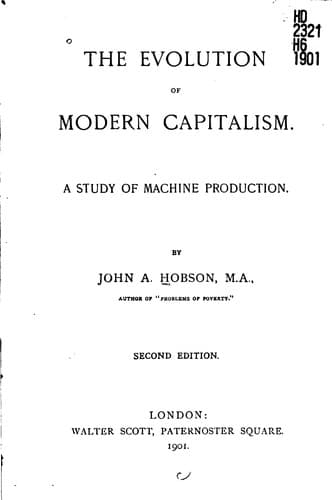
The Evolution of Modern Capitalism: A Study of Machine ProductionHobson, J. A. (John Atkinson)
History
The Evolution of Modern Capitalism: A Study of Machine Production
Hobson, J. A. (John Atkinson)
Capitalism; Industries -- History; Machinery in the workplace
Though Mill does not seem, in Bk. I. chap, v., to regard increased
plant, machinery, etc., as "savings," but rather as something for
which "savings" may be exchanged,[160] the more usual economic view of
"savings" embodies part of them in plant and raw material, etc., and
considers the working up of these into finished goods as a
"consumption." But though industrial usage speaks of cotton yarn,
etc., being consumed when it is worked up, the same language is not
held regarding machinery, nor would any business man admit that his
"capital" was consumed by the wear and tear of machinery, and was
periodically replaced by "saving." The wearing away of particular
material embodiments of capital is automatically repaired by a process
which is not saving in the industrial or the economic sense. No
manufacturer regards the expenditure on maintenance of existing plant
as "saving"; what he puts into additional plant alone does he reckon
"savings." It would be well for economists to clearly recognise that
this business aspect of capital and saving is also the consistent
scientific aspect. "Saving" will then be seen to apply exclusively to
such increased production of plant and productive goods as will
afterwards yield an increased crop of consumptive goods, provided the
community is willing to consume them. "Saving" is postponed
consumption--_i.e._, the production of "future goods," plant,
machinery, raw materials in their several stages, instead of
commodities suitable for immediate consumption.
§ 9. There are, in fact, two distinct motives which induce individuals
to continue to produce, one is the desire to consume, the other the
desire to save--_i.e._, to postpone consumption. It is true that the
latter may be said also to involve a desire to consume the results of
the savings at some indefinitely future time, but the motive of their
production at present is a desire to reduce the quantity of the
present consumption of the community, and to increase the quantity of
postponed consumption.
Public-domain text, read in full here on John Shaqi.
Reviews
Reviews
No reviews yet
Be the first to share your thoughts on this work.
Elsewhere in the archive
Join the Discussion
Join the discussion
Sign in to leave a comment or review.
Sign InorCreate an account