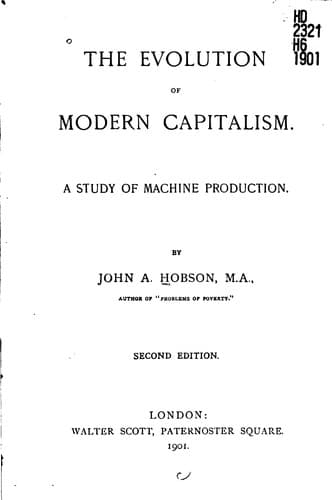
The Evolution of Modern Capitalism: A Study of Machine ProductionHobson, J. A. (John Atkinson)
History
The Evolution of Modern Capitalism: A Study of Machine Production
Hobson, J. A. (John Atkinson)
Capitalism; Industries -- History; Machinery in the workplace
We are not, however, at liberty to infer from Schulze-Gaevernitz's
statement regarding the increased number of spindles and looms an
operative tends, that an intensification of labour correspondent with
this increase of machinery has taken place, nor can the increased
output per operative be imputed chiefly to improved skill or energy of
the operative. Much of the labour-saving character of recent
improvements, especially in the carding, spinning, and intermediate
processes, has reduced to an automatic state work which formerly taxed
the energy of the operative, who has thereby been enabled to tend more
machinery and to quicken the speed without a net increase of working
energy.
In the carding, slubbing, intermediate, roving, and spinning machinery
there is in every case an increase in the amount of machinery tended.
But carding machinery has been revolutionised within the last few
years; the drawing frame has been made to stop automatically when
there is a fault, thus relieving the tender of a certain amount of
supervision; in the slubbing, intermediate, and roving frames certain
detailed improvements have been effected, as is also the case in the
spinning mules and sizing machines.
To some extent the increased quantity of spindles, etc., and increased
speed may be regarded as set off by relief due to these improvements.
Moreover, though there has no doubt been some general speeding up, any
exact measurement is hardly possible, for the speed of machinery is
very often regulated by the amount of work each process is made to do;
for example, if a roving frame makes a coarse hank, the speed of the
spindles does not require to be so great as when the hank is finer; in
that case the mule draws out the sliver to a greater extent than when
the roving is finer, or, in other words, the mule in one case does the
work of the roving frame to a certain extent.
The general opinion seems to be that in the spinning mills, roughly
speaking, 75 per cent. of the increased output per operative may be
imputed to improved machinery, 25 per cent. to increased intensity of
labour in regard to quantity of spindles or "speeding up."
Public-domain text, read in full here on John Shaqi.
Reviews
Reviews
No reviews yet
Be the first to share your thoughts on this work.
Elsewhere in the archive
Join the Discussion
Join the discussion
Sign in to leave a comment or review.
Sign InorCreate an account