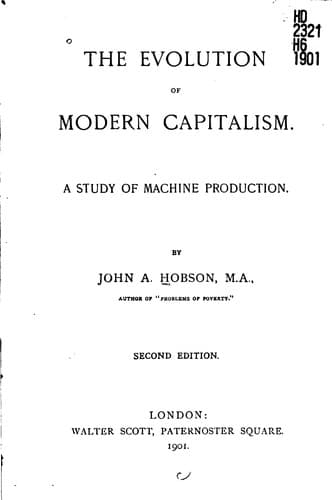
The Evolution of Modern Capitalism: A Study of Machine ProductionHobson, J. A. (John Atkinson)
History
The Evolution of Modern Capitalism: A Study of Machine Production
Hobson, J. A. (John Atkinson)
Capitalism; Industries -- History; Machinery in the workplace
The growth of machinery has acted as an enormous stimulus to the study
of natural laws. A larger and larger proportion of human effort is
absorbed in processes of invention, in the manipulation of commerce on
an increasing scale of magnitude and complexity, and in such
management of machinery and men as requires and educates high
intellectual faculties of observation, judgment, and speculative
imagination. Of that portion of workers who may be said, within
limits, to control machinery, there can be no question that the total
effect of machinery has been highly educative.
The growing size, power, speed, complexity of machinery, undoubtedly
makes the work of this class of workers "more intellectual." Some
measure of these educative influences even extends to the "hand" who
tends some minute portion of the machinery, so far as the proper
performance of his task requires him to understand other processes
than those to which his labour is directly and exclusively applied.
So likewise consideration must be taken of the skilled work of making
and repairing machinery. The engineers' shop and other workshops are
becoming every year a more and more important factor in the equipment
of a factory or mill. But though "breakdowns" are essentially erratic
and must always afford scope for ingenuity in their repair, even in
the engineers' shop there is the same tendency for machinery to
undertake all work of repair which can be brought under routine. So
the skilled work in making and repairing machinery is continually
being reduced to a minimum, and cannot be regarded, as Professor
Nicholson is disposed to regard it, as a factor of growing importance
in connection with machine-production. The more machinery is used, the
more skilled work of making and repairing will be required, it might
seem. But the rapidity with which machinery is invading these very
functions turns the scale in the opposite direction, at any rate so
far as the making of machinery is concerned. Statistics relating to
the number of those engaged in making machinery and tools show that
the proportion they bear to the whole working population is an
increasing one; but the rate of this increase is by no means
proportionate to the rate of increase in the use of machinery. While
the percentage of those engaged in making machinery and tools rises
from 1.7 in 1861 to 1.8 in 1871 and 1.9 in 1881, 2.0 in 1891, the
approximate increase of steam-power applied to fixed machinery and
locomotives shows a much more rapid rise,--from 2,100,000 horse-power
in 1860 to 3,040,000 in 1870 and 5,200,000 in 1880.[214] Moreover, an
increased proportion of machinery production is for export trade, so
that a large quantity of the labour employed in those industries is
not required to sustain the supply of machinery used in English work.
In repairs of machinery, the economy effected by the system of
interchangeable parts is one of growing magnitude, and tends likewise
to minimise the skilled labour of repair.[215]
Public-domain text, read in full here on John Shaqi.
Reviews
Reviews
No reviews yet
Be the first to share your thoughts on this work.
Elsewhere in the archive
Join the Discussion
Join the discussion
Sign in to leave a comment or review.
Sign InorCreate an account