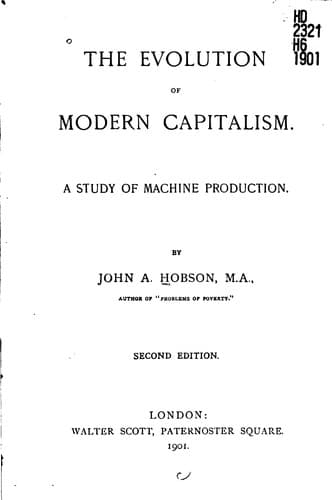
The Evolution of Modern Capitalism: A Study of Machine ProductionHobson, J. A. (John Atkinson)
History
The Evolution of Modern Capitalism: A Study of Machine Production
Hobson, J. A. (John Atkinson)
Capitalism; Industries -- History; Machinery in the workplace
§ 12. It cannot, however, reasonably be maintained that the whole of
this economic advantage owned by weavers and other women workers in
Lancashire is due directly to organisation. It is no doubt partly due
to the conditions which also make Trade Unionism effective, an
abundant demand for female labour in relation to the supply. In the
less concentrated woollen industries of the West of England, where a
large supply of female labour is available beyond the demand, the
difference between men's and women's wages is far greater than it is
even in those parts of Yorkshire where women are but slightly
organised. This brings us to the most vital point in the problem of
the industrial position of women. When there is an over-supply of
labour qualified to compete for any work, wages must fall to the
minimum of "wants" unless those in possession of the work are so
strongly organised as to prevent outsiders from effectively competing.
In a highly-skilled trade the workers may often have a practical
monopoly of the skill, which gives them both power to organise and
power when organised. But in a low-skilled trade, or where employers
are able to introduce unlimited numbers of girls into the trade, there
exists no such power to organise. Those who most need organisation are
least able to organise. This is the crux for low-skilled male labour,
and the great mass of women's industries are in the same economic
condition, because the kind of skill required is possessed or easily
attainable by a much larger number of competitors for work than are
sufficient to meet the demand at a decent wage. The deep abiding
difficulty in the way of organising women workers lies here. Cut out
as they are, by physical weakness, by lack of the means of technical
training, in some cases by organised opposition of male workers, or by
social prejudices, from competing in a large number of skilled
industries, their competition within the permitted range of
occupations is keener than among men: not merely in the unskilled but
in the skilled industries the available supply of labour is commonly
far in excess of the demand, for the skill is generally such as is
common to or easily attainable by a large number of the sex. To this
must be added the consideration that a larger proportion of women's
industries are concerned with the production of luxuries which are
peculiarly subject to fluctuation of trade by the elements of season,
weather, fashion, and rise or fall of incomes. Finally, a much larger
proportion of women's work is done in small factories, in workshops,
and in the home, under conditions which are inimicable to the
effective organisation of the workers. Until out-work is much
diminished, and effective inspection and limitation of hours in small
workshops drives a much larger proportion of women workers into large
factories, where closer social intercourse can lay the moral
foundation of trade organisation in mutual acquaintance, trust, and
Public-domain text, read in full here on John Shaqi.
Reviews
Reviews
No reviews yet
Be the first to share your thoughts on this work.
Elsewhere in the archive
Join the Discussion
Join the discussion
Sign in to leave a comment or review.
Sign InorCreate an account