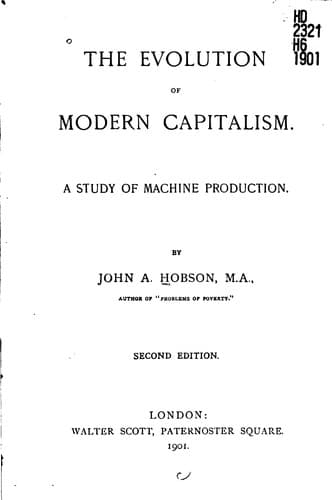
The Evolution of Modern Capitalism: A Study of Machine ProductionHobson, J. A. (John Atkinson)
History
The Evolution of Modern Capitalism: A Study of Machine Production
Hobson, J. A. (John Atkinson)
Capitalism; Industries -- History; Machinery in the workplace
In Canada there is the same diminution of rural and growth of town
population. New Brunswick contains 14 counties; in the decade 1871-81
only one of these showed a slight diminution, but not less than 7 in
the decade 1881-91. The 18 counties of Nova Scotia all showed an
increase in 1871-81, 8 showed a decrease in 1881-91. Quebec contains
61 counties, 10 of which showed a decrease in 1871-81, 26 in 1881-91.
Ontario has 48 counties, only 4 of which showed slight decrease in
1871-81; 20 showed a much more rapid decrease in 1881-91.
The following table shows that the accelerating decrease of the rural
parts is accompanied by a correspondingly accelerating increase of the
chief towns:--
----------------+----------+----------+----------
| 1871. | 1881. | 1891.
----------------+----------+----------+----------
Kingston[274] | 12,407 | 14,091 | 19,264
London | 15,826 | 26,266 | 31,977
Ottawa | 21,545 | 31,307 | 44,154
Hamilton | 26,717 | 35,961 | 48,980
Toronto | 56,092 | 96,196 | 181,220
----------------+----------+----------+----------
| 132,586 | 203,821 | 325,595
----------------+----------+----------+----------
The portentously rapid growth of the largest cities is of course not
wholly attributable to economic causes. To form the capital cities of
the New World, political and social influences have co-operated with
industrial. Nor can these causes be ignored in explaining the rapid
growth of certain European capitals, especially Berlin, Paris,
London, and Vienna. But the effective operation of these forces is
largely dependent on the modern machinery of transport, and in the
main these great centres must be regarded as manufacturing and
commercial towns.
Though the lack of any common statistical basis prevents us from being
able to trace with exactitude the comparative pace of this movement in
different countries, we know enough to justify the general conclusion
that this centralising tendency varies directly with the degree of
material civilisation attained in the several countries by the mass of
the population. In England, France, United States, Australia, where
steam engines, electric light, newspapers, and all the most highly
elaborated mechanical contrivances are available in towns, the growth
of town life is most rapid; in Russia, Turkey, India, Egypt, where
mechanical development is still far behind, the townward march is far
slower. As the area of machine-industry spreads, so this movement of
population will become more general, and as towns grow larger so it
would appear that this power to suck in the rural population is
stronger and more extensive.
Public-domain text, read in full here on John Shaqi.
Reviews
Reviews
No reviews yet
Be the first to share your thoughts on this work.
Elsewhere in the archive
Join the Discussion
Join the discussion
Sign in to leave a comment or review.
Sign InorCreate an account